The problem
Pharmaceutical manufacturing under ISO 14644 cleanroom classification requires epoxy systems with documented particle-generation rates and ESD compliance where validation demands.
Our approach
Industrial Floors Ghana delivers ISO 14644 Class 5-8 compliant epoxy systems with multi-coat application discipline and IEC 61340-5-1 ESD integration for pharma cleanroom-adjacent zones.
Industrial Floors Ghana delivers ISO 14644 Class 5-8 compliant epoxy systems with multi-coat application discipline and IEC 61340-5-1 ESD integration for pharma cleanroom-adjacent zones.
The Challenge
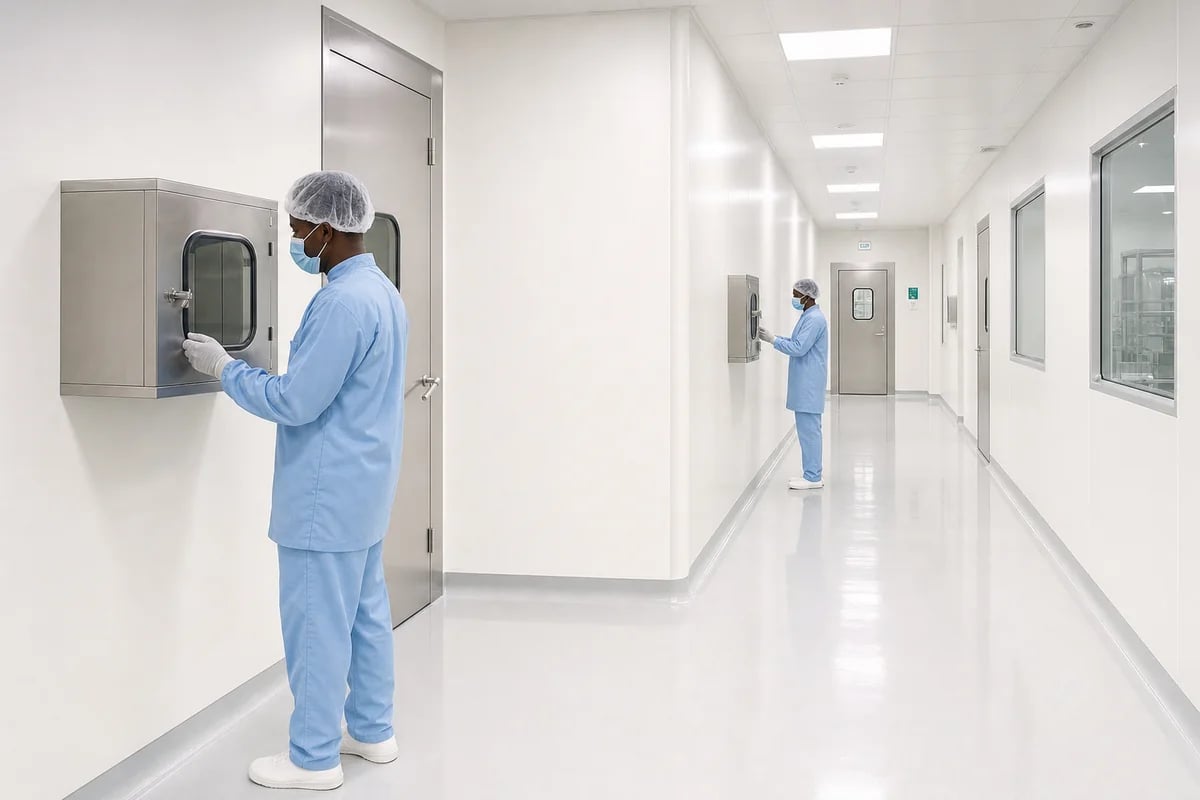
Pharmaceutical manufacturing and cleanroom-adjacent production zones impose a specification burden that standard industrial flooring cannot carry. Where a conventional warehouse floor must manage forklift loads and point-pressure, a pharma-adjacent floor must simultaneously resist aggressive chemical wash-down cycles, suppress particle generation, dissipate electrostatic charge to IEC 61340-5-1 tolerances, and maintain surface integrity under ISO 14644 Class 5–8 cleanliness classifications. These are not competing priorities — they must resolve into a single, precisely installed system.
Ghana’s pharmaceutical manufacturing corridor, concentrated along the Tema Industrial axis, has expanded materially over the past decade. Multinational fill-and-finish operators, API manufacturers, and medical-device assembly facilities now occupy specification-grade facilities where flooring failure carries regulatory consequence — not merely operational inconvenience. A delaminating coating, a surface crack propagating beneath a cleanroom gown-change anteroom, or an ESD exceedance in a dispensing zone can trigger a GMP non-conformance, a batch rejection, or a full facility audit. The floor is not a background element. It is a controlled surface.
The compounding difficulty in West Africa’s equatorial climate is substrate behaviour. Concrete slabs in Tema’s industrial zones absorb ambient humidity seasonally. An uncontrolled moisture vapour emission rate undermines even a well-specified epoxy system within months — not years. ASTM F1869 moisture testing is not optional. It is the non-negotiable precondition for any coating programme that will perform across a 10-to-15-year service horizon.
The Industrial Floors Ghana Solution
Industrial Floors Ghana approaches pharma-adjacent flooring as a sequential, verification-gated programme — not a single installation event. Every engagement opens with substrate assessment: compressive strength confirmation, ASTM F1869 vapour emission testing, crack mapping, and a contamination profile of any prior coating residues. This data governs system selection. No system is specified to a project until the substrate has been characterised and documented.
The multi-coat application sequence employed on cleanroom-adjacent floors is structured to deliver chemical resistance, ESD continuity, and seamless surface closure in a single integrated system. A moisture-tolerant epoxy primer seals the substrate and establishes the adhesion base. A self-levelling epoxy broadcast layer builds the body coat to controlled thickness — typically 3–6 mm depending on traffic classification and chemical exposure regime. A dissipative topcoat, grounded through a continuous copper-tape earthing grid installed to IEC 61340-5-1 requirements, closes the system and delivers a measured surface resistance in the 10⁵–10⁹ Ω range.
Installed under controlled-environment protocols — temperature, humidity, and surface-dew-point managed throughout — the completed system is cured, tested, and certified before any production activity commences. Industrial Floors Ghana provides flatness verification reports, ESD continuity test records, and chemical resistance documentation as a structured handover package at project close.
Material + System Specification
- Base system: Moisture-tolerant epoxy primer, suitable for substrates with vapour emission rates up to 8 lbs/1,000 ft²/24 hrs (ASTM F1869 verified)
- Body coat: Self-levelling solvent-free epoxy, 3–6 mm build, Shore D hardness ≥ 80, chemical resistance to IPA, NaOH (10%), and common pharmaceutical solvents
- ESD integration: Conductive copper-tape earthing grid bonded to structural earth, dissipative topcoat delivering 10⁵–10⁹ Ω surface resistance per IEC 61340-5-1
- Cleanliness classification: System particle emission profile compatible with ISO 14644 Class 5–8 cleanroom-adjacent zoning
- Finish: Seamless, coved-skirting detail available, surface texture calibrated to Rz ≤ 30 µm for wipeability and gowning-area hygiene
- Documentation package: ASTM F1869 test record, ESD continuity certificates, material TDS and SDS, flatness report
Typical Project Profile
A representative engagement covers 600–2,500 m² of production floor, gown-change antechambers, chemical dispensing zones, and connecting corridors within a pharmaceutical manufacturing or medical-device assembly facility in the Tema Industrial or Free Zones Enclave areas. Programme duration runs 3–6 weeks from substrate preparation through certified handover, structured to minimise interference with adjacent live production areas. Sectors served include API manufacturing, fill-and-finish operations, nutraceutical production, and medical-device assembly.
Outcomes
- Regulatory-ready surface documentation — handover package supports GMP audit and facility qualification protocols
- ESD continuity verified — IEC 61340-5-1 compliant earthing grid, tested and recorded at project close
- Extended service life — moisture-controlled substrate preparation and solvent-free chemistry deliver 12–18-year service horizon under standard pharma wash-down regimes
- Zero delamination risk — vapour emission testing conducted prior to every coat, eliminating the primary failure mechanism in Ghana’s equatorial climate
- 51 years of industrial track record — founded 1975, Industrial Floors Ghana has delivered pharma-adjacent and cleanroom-grade flooring programmes across Ghana’s industrial zones for over five decades