Heavy-Traffic Flooring
High-build, abrasion-resistant industrial flooring in Tema & Accra — broadcast and mortar epoxy and PU systems for forklift, AGV and impact loads, tested to ASTM D4060 and ASTM C779, over moisture-verified slabs (ASTM F2170/F1869) that prevent the
Heavy-traffic flooring is a high-build, abrasion-resistant resin system installed over a moisture-verified concrete slab to carry continuous forklift, AGV and impact loading without grooving, abrading or delaminating. In Ghana’s humidity its longevity is decided beneath and within the system — by slab moisture testing, deep substrate preparation, and full film thickness. Industrial Floors Ghana has installed heavy-traffic floors across Tema and Accra since 1975.
Why Heavy-Traffic Floors Fail in Ghana’s Conditions — and How We Prevent It
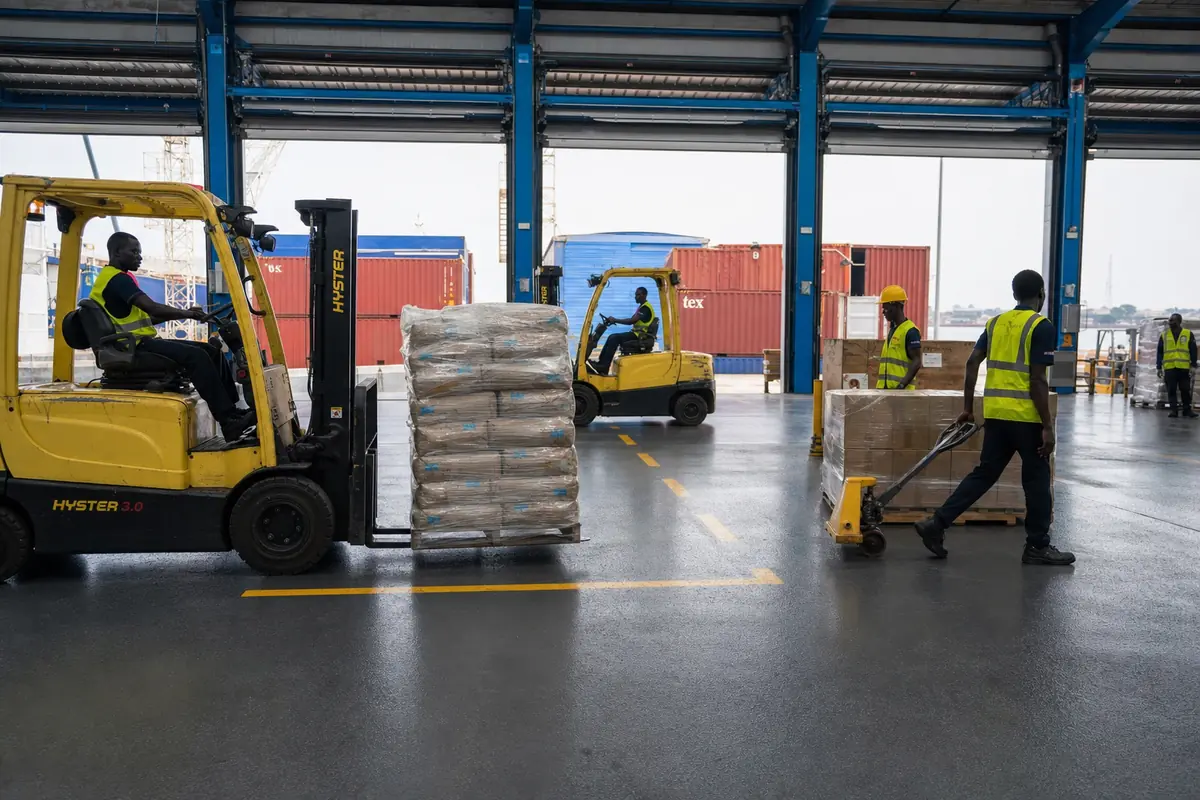
Heavy-traffic floors fail two ways, and both are preventable. The first is slab moisture: in Ghana’s persistent 81–83% relative humidity, vapour rising through the slab builds osmotic and hydrostatic pressure under the system and lifts it — and under heavy wheel loads a lifted coating shatters fast. It is the single most common industrial-floor failure in the country, and almost every failed floor skipped one step: slab moisture testing before the system went down.
The second is under-specifying film thickness for the actual traffic. A thin coating cannot absorb the continuous abrasion and impact of forklift racetracks and AGV guide paths; it grooves and wears through to the substrate. We treat both as primary engineering controls — testing in-situ relative humidity to ASTM F2170 and moisture-vapour emission to ASTM F1869, priming to the reading, then building a high-build system whose abrasion resistance is verified to ASTM D4060 and ASTM C779 for the duty.
Heavy-Traffic Systems We Install in Tema & Accra
High-Build Broadcast / Quartz Epoxy
A heavily aggregate-loaded, full-thickness system for the most-trafficked distribution and dispatch floors — engineered so abrasion wears the sacrificial broadcast layer, not the structural body.
Mortar-Body (Trowel-Applied) Epoxy
The maximum-mass resin option for impact zones and the heaviest rolling loads — battery bays, dispatch lanes and reach-truck aisles where dropped loads and constant wheel traffic would defeat a broadcast coating.
Heavy-Duty PU Systems
For heavy traffic combined with wash-down, thermal shock or chemical splash — cold-chain and food-and-beverage logistics — where PU tolerates wet and thermal cycling that standard epoxy cannot.
AGV & Forklift Racetrack Zones
Wear-lane detailing for automated guided vehicle paths and forklift racetracks: deeper film build and a planned recoat strategy on the lanes that take the punishment, so the rest of the floor is never disturbed.
The Standards Doctrine — Moisture & Abrasion
| Test / Standard | What it measures | Why it decides the floor |
|---|---|---|
| ASTM F2170 | In-situ relative humidity (probes at 40% slab depth) | The dominant pre-install moisture test; system and primer are chosen to this reading |
| ASTM F1869 | Calcium-chloride moisture-vapour emission rate | Surface vapour load; flags slabs that need a vapour-suppression primer |
| ASTM D4060 | Taber abrasion resistance (mass loss) | Rates the system’s wear durability for the traffic duty |
| ASTM C779 | Abrasion resistance of horizontal concrete surfaces | Benchmarks the slab and topping under rolling and foot traffic |
| ICRI CSP | Concrete surface profile after preparation | The mechanical key a high-build system bonds to — concrete uses ICRI CSP, not the steel-only ISO 8501 |
| ASTM D3359 | Coating adhesion (crosshatch tape test) | Verifies the bond achieved at handover |
How We Install a Heavy-Traffic Floor
- Slab moisture & traffic survey — ASTM F2170 in-situ RH + ASTM F1869 MVER, plus forklift class, AGV routing and wheel type, before anything else.
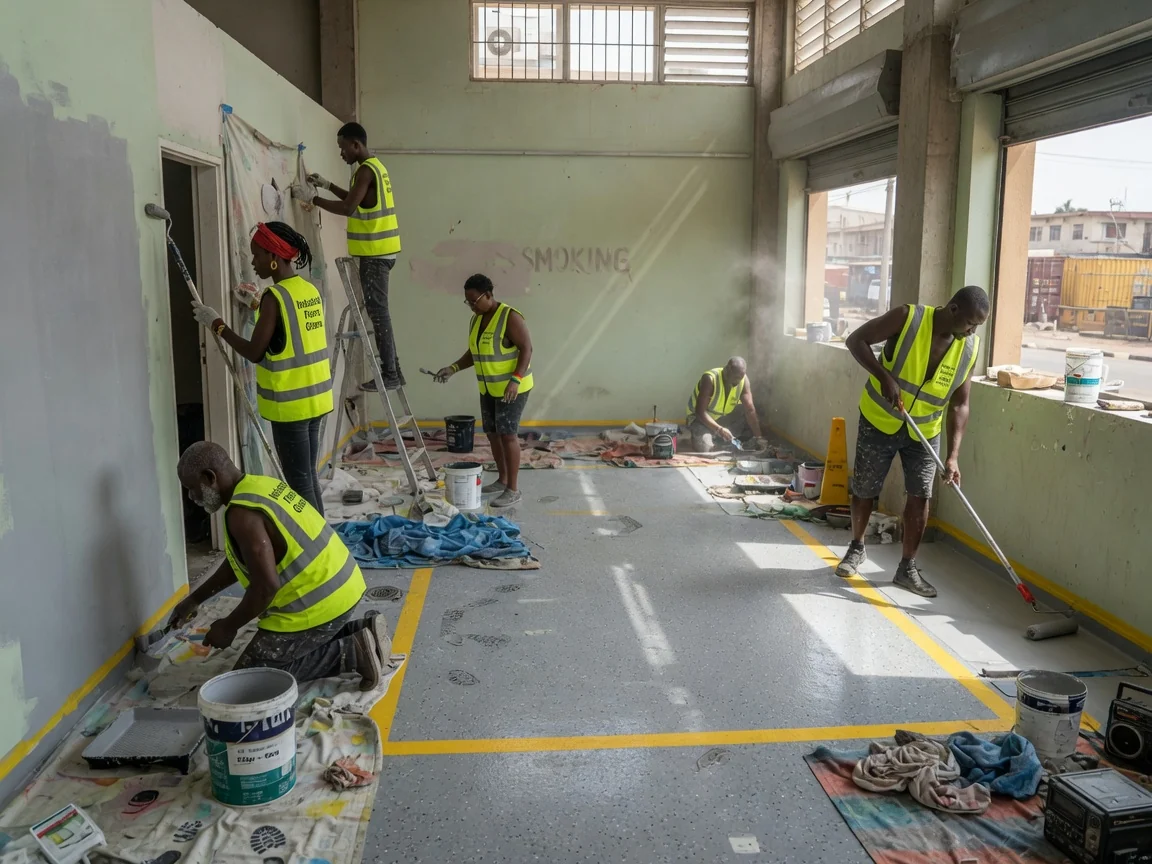
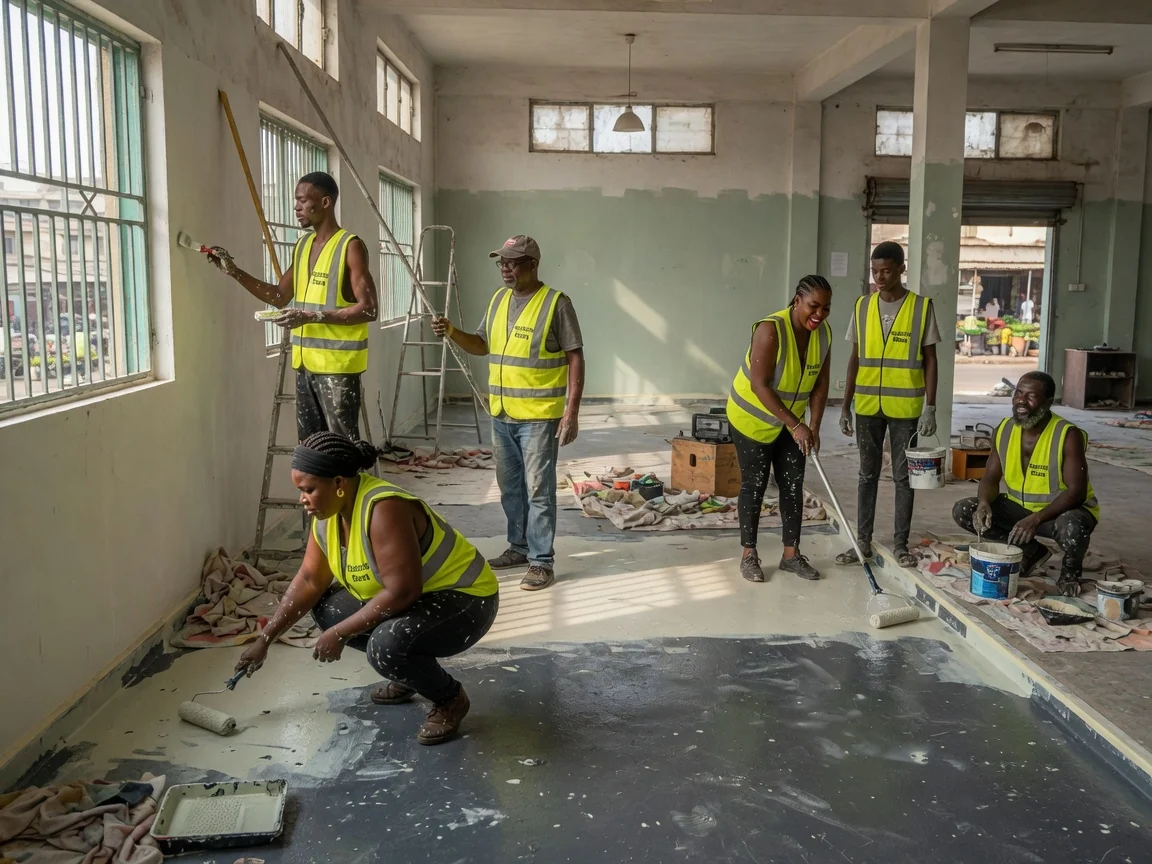
- Surface preparation — shot-blasting / diamond grinding to a deep ICRI CSP; delaminated and cracked zones cut out and rebuilt.
- High-build system installation — moisture-tolerant primer to the reading, then high-build broadcast/mortar epoxy or PU at full thickness; abrasion verified to ASTM D4060 / C779.
- Verification, recoat plan & handover — adhesion (ASTM D3359), agreed wear-lane recoat strategy, signed QC report.
Comparing Heavy-Traffic Systems for Ghana’s Climate
| System | Best for | Wear behaviour | Moisture tolerance |
|---|---|---|---|
| High-build broadcast epoxy | Most-trafficked distribution & dispatch | Sacrificial broadcast wears first | High when slab is tested & primed |
| Mortar-body epoxy | Impact zones, battery bays, reach-truck aisles | Maximum mass; resists grooving | High; thick build |
| Heavy-duty PU | Heavy traffic + wash-down / thermal shock | Tolerant of wet & thermal cycling | Highest |
| Recoat-managed wear lanes | AGV paths & forklift racetracks | Topped up on planned interval | Per base system |
What Affects the Cost
- The system specified (high-build broadcast, mortar epoxy, or heavy-duty PU) and its film build
- Slab condition and any moisture remediation, crack repair or zone rebuild required
- Abrasion and impact rating, and the wear-lane recoat strategy
- Area (m²), access, and whether the facility stays operational during works
Every quote follows a site survey and slab moisture test — no fixed rate is given before the slab is tested. Warranties are system- and manufacturer-backed and conditional on the specified prep, build and recoat maintenance.
Applications Across Ghana
- Port-adjacent logistics, bonded warehouses and FMCG palletisation hubs across the Tema industrial area and Spintex
- Forklift racetracks, dispatch lanes and AGV guide paths in high-throughput distribution centres
- Battery-charging and reach-truck aisles; automotive and steel-stockholding floors
- Cold-chain and food-and-beverage logistics requiring heavy-duty PU
- Heavy-industrial and process plants across the Accra–Tema industrial belt
Areas We Serve
Industrial Floors Ghana installs heavy-traffic flooring across the Tema industrial area, Spintex, North Industrial Area, and Greater Accra, reaching Kumasi and Takoradi’s port and petrochemical zones.
Related Services
- Warehouse Floors — load-bearing, flatness-certified storage and distribution slabs
- Industrial Epoxy Floors — the resin systems behind every heavy-traffic floor
- Loading-Dock Surfaces — durable, slip-rated dock and apron finishes
- Chemical-Resistant Coatings — for processing and bunded areas
Frequently Asked Questions
What flooring withstands the heaviest forklift and AGV traffic? A high-build broadcast or mortar-body epoxy, or a heavy-duty PU system, installed at full thickness over a moisture-tested, ICRI-CSP-prepared slab and specified for abrasion to ASTM D4060 / ASTM C779. The mass of the system — not a thin film — is what absorbs continuous wheel and impact loading.
Why does heavy-traffic flooring wear out so fast in Ghana? Two reasons: slab moisture lifting the system, and an under-specified film thickness for the traffic. In Ghana’s 81–83% humidity we test in-situ RH (ASTM F2170) and MVER (ASTM F1869) and prime to the reading, then build to the wheel and impact load so the surface abrades slowly and predictably, not catastrophically.
How do you handle wear lanes without re-doing the whole floor? We map the high-wear lanes — forklift racetracks, AGV guide paths, turning points — and agree a recoat strategy at handover. Those zones are abraded and topped up on a planned interval, extending the life of the whole floor and avoiding a full replacement.
How much does heavy-traffic flooring cost? It is quoted on survey — cost varies with the system and film build, slab condition and moisture remediation, abrasion and impact rating, area and access. We never give a fixed rate before testing the slab; request a site survey.