The problem
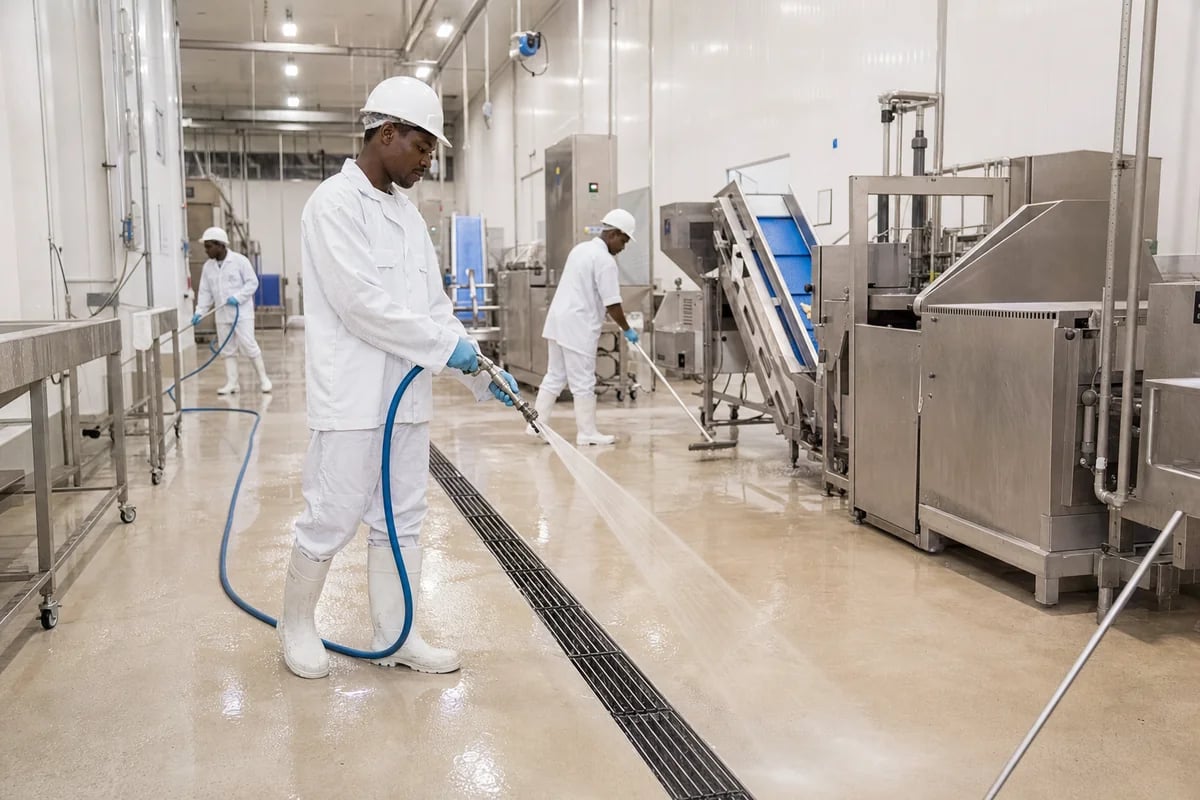
Food processing operations under HACCP audit require flooring satisfying FDA food-contact compatibility, integrated coved bases, antimicrobial finish, and wash-down resistance.
Our approach
Industrial Floors Ghana installs food-grade hygienic flooring with seamless coved bases, FDA-compliant antimicrobial systems, and full HACCP-aligned QC documentation.
Industrial Floors Ghana installs food-grade hygienic flooring with seamless coved bases, FDA-compliant antimicrobial systems, and full HACCP-aligned QC documentation.
The Challenge
Food processing and beverage manufacturing facilities operate under a compliance burden that extends well below the production line — down to the floor itself. Ghana’s Food and Drugs Authority mandates hygienic surface standards that eliminate bacterial harbourage, resist aggressive chemical washdowns, and maintain structural integrity under the thermal cycling of high-pressure steam cleaning. A floor that fails on any one of these dimensions does not merely underperform — it becomes a contamination vector, a regulatory liability, and a production shutdown waiting to be documented.
The sector context compounds the difficulty. Food-grade facilities in Tema’s industrial corridor and across Ghana’s agro-processing zones typically inherit concrete substrates that were never specified for hygienic service: surface porosity, open-joint construction, inadequate drainage gradients, and carbon-steel drainage channels that accumulate biofilm. Retrofitting these substrates to full HACCP alignment demands substrate remediation, moisture management to ASTM F1869 standards, and a continuous-membrane system with no joints for pathogen colonisation.
Regulatory audit cycles further raise the stakes. HACCP assessments, FDA Ghana inspections, and export-certification audits all include documented floor inspections. A facility that cannot produce installation records, material data sheets, antimicrobial certification, and a signed flatness report is structurally exposed — regardless of how clean the surface appears on the day of the visit.
The Industrial Floors Ghana Solution
Industrial Floors Ghana has specified and installed food-grade hygienic flooring systems since 1975 — accumulating 51 years of substrate knowledge specific to Ghana’s tropical humidity, groundwater profiles, and FDA Ghana compliance cycles. The methodology begins with substrate assessment: concrete compressive strength testing, ASTM F1869 calcium chloride moisture emission testing, and drainage gradient survey before a single material is committed to the floor.
The installation system centres on a seamless, solvent-free antimicrobial epoxy or polyurethane cementitious membrane laid over a prepared substrate, transitioning at all wall junctions to a fully coved base — typically 100 mm radius — eliminating the right-angle joint where moisture and bacteria accumulate in conventionally tiled facilities. The coved base is monolithic with the floor system, not a separate ceramic component, ensuring the hygienic barrier is continuous. Drainage channels are specified in stainless steel, set to a surveyed fall, and integrated into the membrane perimeter before final topcoat application.
All systems are documented to HACCP alignment: material data sheets, antimicrobial certification references, installation records, and a signed QC completion report are delivered as a compliance package alongside the finished floor.
Material + System Specification
- Substrate primer: solvent-free epoxy penetrating primer, moisture-tolerant to 4% CM, closing surface porosity before membrane application
- Wearing membrane: polyurethane cementitious (PU cement) or solvent-free epoxy at 4–9 mm build, with antimicrobial additive system certified to ISO 22196
- Coved base: 100 mm radius monolithic cove formed from the same wearing-layer compound, eliminating the wall-floor junction joint
- Drainage integration: stainless-steel channel bodies, set to surveyed gradient minimum 1:80, sealed into membrane perimeter
- Topcoat: anti-slip, chemical-resistant, UV-stable finish coat rated to resist lactic acid, caustic soda, and hypochlorite concentrations used in CIP washdown cycles
- QC documentation: ASTM F1869 moisture test records, material certifications, installation sign-off, and HACCP-aligned completion report
Typical Project Profile
A representative project covers 800–4,000 m² of production floor, washdown corridor, and cold-store antechamber across a food-grade manufacturing facility or beverage plant. Substrate remediation, drainage reconfiguration, membrane installation, and coved-base formation are sequenced in sectional bay closures to preserve live production in adjacent areas where facility operations permit. Full installation, curing, and QC documentation are typically completed within three to six weeks depending on facility scale and substrate condition. Sectors served include poultry processing, dairy and beverage manufacturing, bakery and confectionery production, and pharmaceutical-adjacent nutraceutical facilities.
Outcomes
- Seamless, coved, joint-free floor surface eliminating bacterial harbourage at all wall-floor junctions
- Full HACCP-aligned QC documentation package ready for FDA Ghana and export-certification audit review
- Chemical resistance verified against CIP washdown agents including caustic soda, hypochlorite, and lactic acid
- Anti-slip surface rating maintained under wet washdown conditions throughout the service life of the system
- 51-year installation track record providing clients with a documented specification baseline for asset maintenance planning