Polished Concrete
Diamond-ground polished concrete floors in Tema & Accra — mechanical grind-and-polish with lithium-silicate densifier delivering gloss-rated, dust-free surfaces for showrooms, retail, corporate and warehouse floors, with no resin film to lift in Ghana's humidity. Industrial Floors Ghana, since 1975.
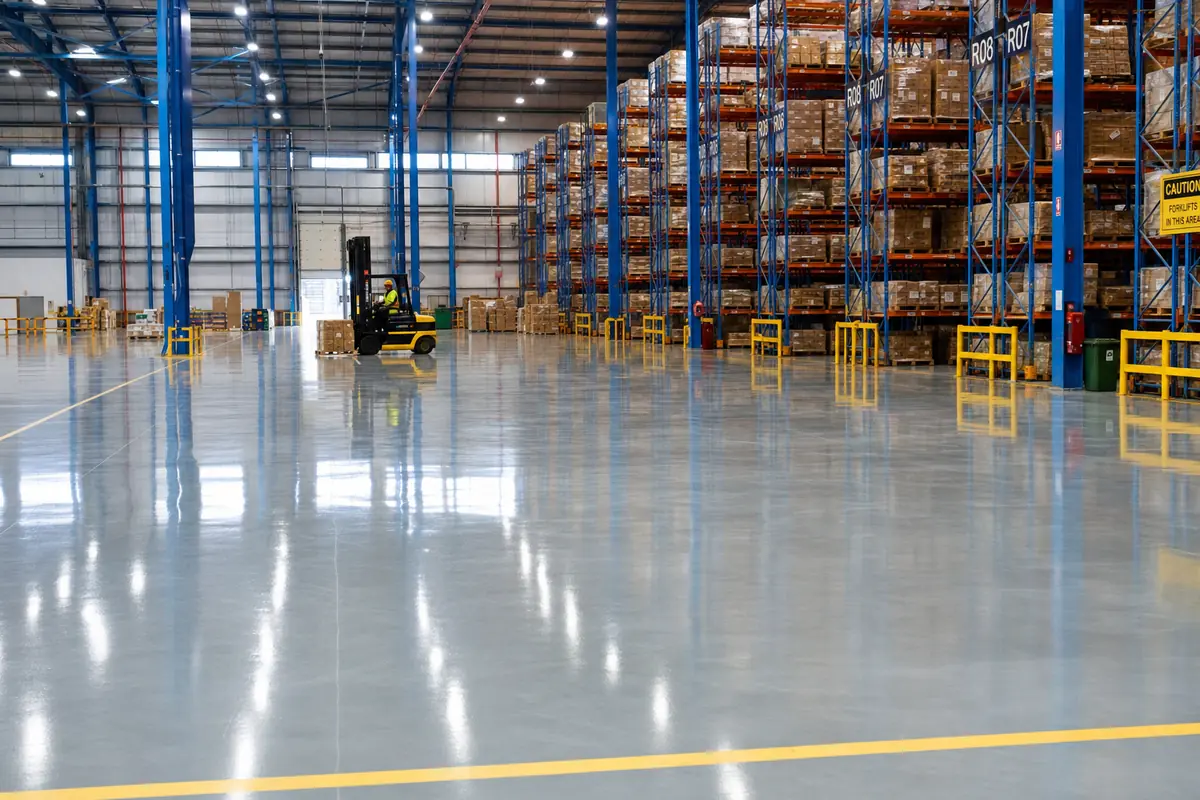
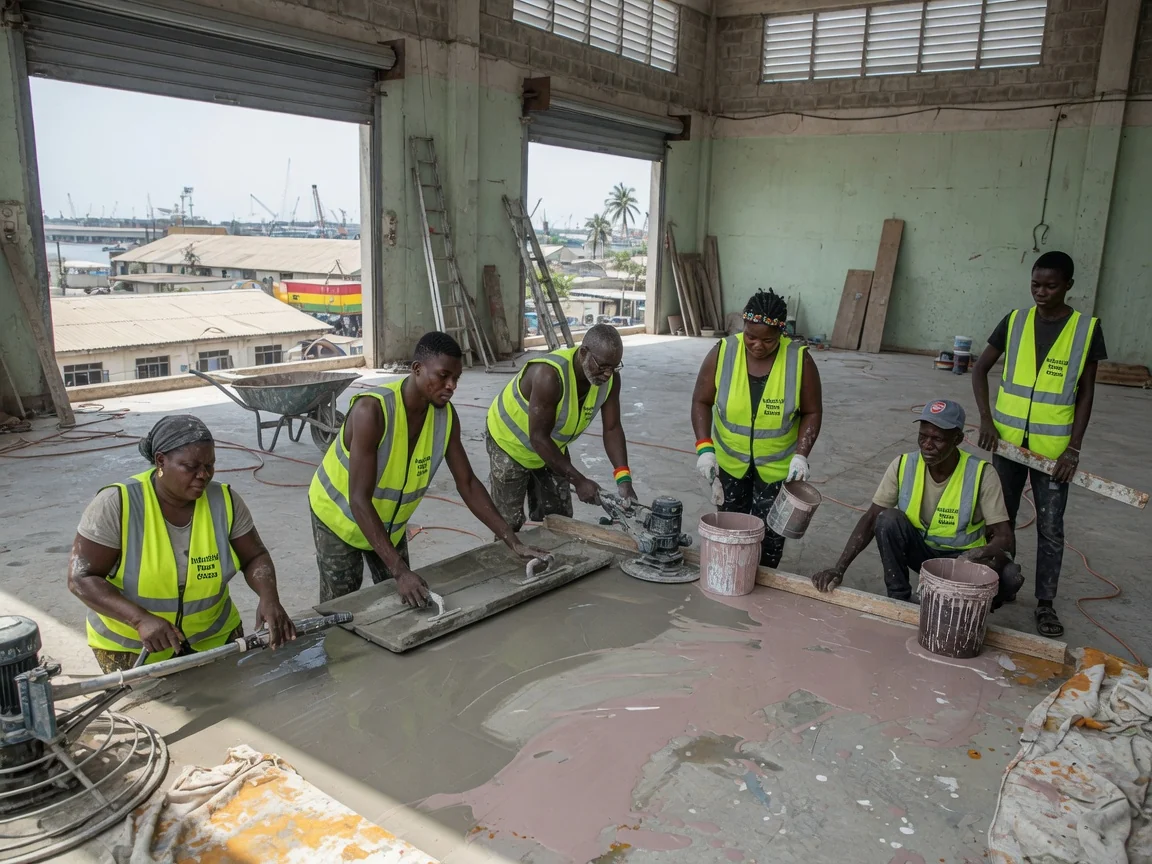
Polished concrete is a mechanical grind-and-polish process that refines a concrete slab through progressively finer diamond tooling and a penetrating densifier into a hard, dust-free, gloss-rated wearing surface — integral to the slab itself, with no applied resin film. The finish is specified by gloss level and aggregate exposure, not left to chance. Industrial Floors Ghana has ground and polished concrete across Tema and Accra since 1975.
Why Polished Concrete Suits Ghana’s Conditions
Polished concrete carries a climate advantage that no coating can match: there is no resin film to lift. In Ghana’s persistent 81–83% relative humidity, moisture vapour rising through a slab builds pressure under any coating and blisters or delaminates it — the single most common industrial-floor failure in the country. Because a polished floor is ground and densified into the concrete itself, there is nothing for that vapour to push off. The same humidity that destroys a poorly-prepared epoxy floor is simply irrelevant to a polished slab.
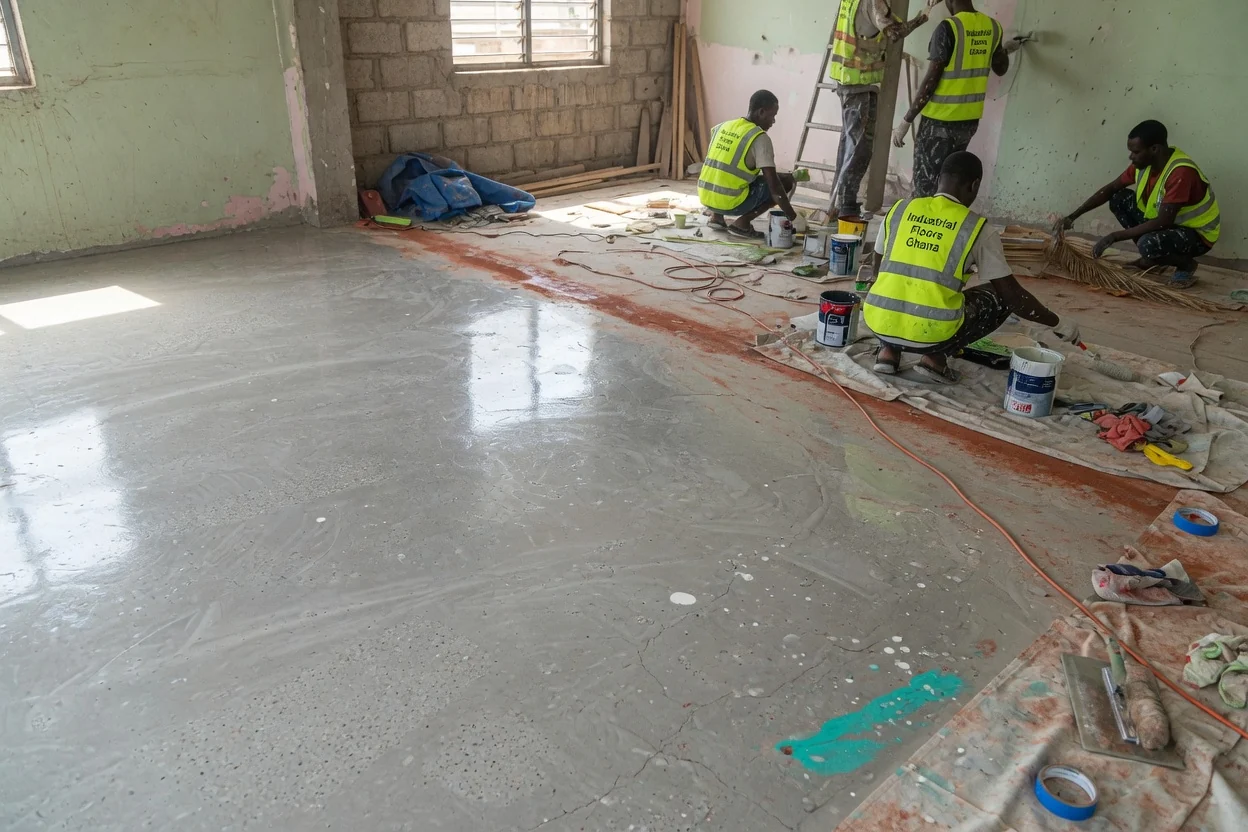
It is also dust-free for life. A penetrating lithium-silicate densifier reacts inside the concrete to harden the surface and eliminate the laitance dusting that plagues bare slabs in warehouses and showrooms alike. The result is a low-maintenance, light-reflective floor that needs no recoating cycle — ground once, densified once, and left to wear in.
Polished Concrete Systems We Install in Tema & Accra
Mechanical Grind-and-Polish
The core system: a progressive diamond grind from coarse metal-bond tooling through fine resin-bond diamonds, refining the slab to a specified gloss with no topical coating.
Densifier-Hardened Polish
Lithium-silicate densifier driven into the slab during the polishing sequence to raise surface hardness, stop dusting, and lock in the finish — the dust-free, no-film core of every floor we deliver.
Dyed / Decorative Concrete
Penetrating concrete dyes worked into the slab before final polishing for showrooms and retail where a coloured, light-reflective floor is wanted without the moisture risk of a decorative resin.
Burnished Finish
A high-gloss, high-reflectivity polish taken through the finest grits for corporate lobbies and showrooms where appearance is the governing requirement.
| Gloss / aggregate level | Finish | Best for |
|---|---|---|
| Matte, cream (cement) finish | Low sheen, no stone showing | Warehouse, light-industrial, back-of-house |
| Satin, salt-and-pepper | Medium sheen, fine aggregate just visible | Retail, light-commercial, corporate floors |
| Semi-gloss, salt-and-pepper | Reflective, fine aggregate exposed | Showrooms, offices, public areas |
| High-gloss, aggregate exposure | Mirror-like, full stone aggregate exposed | Premium showrooms, corporate lobbies |
The Standards We Polish To
| Standard | What it measures | Why it decides the floor |
|---|---|---|
| ASTM C779 | Abrasion resistance of horizontal concrete surfaces | The wear test that confirms a densified polished floor will hold up under traffic |
| ICRI CSP | Concrete surface profile / surface condition | Concrete is read by ICRI CSP, not the steel-only ISO 8501; it governs how the slab grinds and densifies |
| Mohs / gloss measurement | Surface hardness and measured gloss level | The finish is specified and verified — gloss is measured to the agreed level, not judged by eye |
How We Install a Polished Concrete Floor
- Slab assessment & grind sequence — assess hardness, flatness and surface condition, then open the surface with coarse metal-bond diamond tooling to the chosen aggregate-exposure level.
- Lithium-silicate densification — penetrating densifier applied at the correct stage to harden the surface, stop dusting, and lock in the polish.
- Polish to the specified gloss — step through finer resin-bond diamonds to the agreed gloss level (matte, satin, semi-gloss or high-gloss), measured not guessed.
- Seal, verify & handover — penetrating guard where the use requires it; gloss, aggregate exposure and flatness checked, recorded, and signed off.
Comparing Polished Concrete with Coated Floors for Ghana’s Climate
| System | Best for | Lifespan | Moisture behaviour in Ghana |
|---|---|---|---|
| Polished concrete | Showrooms, retail, corporate, light-commercial, warehouse | 20+ yrs | No resin film — slab moisture cannot lift it |
| Self-levelling epoxy | FMCG, automotive, general production | 10–15+ yrs | Needs slab moisture testing & priming or it blisters |
| Broadcast / mortar epoxy | Warehouses, docks, forklift traffic | 12–20 yrs | High when slab is tested; thick build |
| PU screed | Food/pharma wash-down, thermal shock | 15–20 yrs | Highest; tolerates wet/thermal cycling |
What Affects the Cost
- The slab’s existing condition, hardness, and how much repair or remediation it needs before polishing
- The gloss level and aggregate-exposure level specified (cream, salt-and-pepper, or full aggregate)
- The grind sequence required — a harder or more damaged slab takes more passes
- Area (m²), access, and whether the facility stays operational during works
Every quote follows a site survey of the slab — no fixed rate is given before the concrete is assessed.
Applications Across Ghana
- Showrooms and retail floors across Greater Accra where a coloured or high-gloss, dust-free floor is wanted without resin
- Corporate lobbies, offices, and public-area floors needing a measured, light-reflective finish
- Light-commercial and warehouse floors where a dust-free, low-maintenance surface beats a coating
- Distribution and logistics floors in the Tema industrial area and Spintex
- Commercial and institutional facilities in Takoradi
Areas We Serve
Industrial Floors Ghana grinds and polishes concrete across the Tema industrial area, Spintex, North Industrial Area, and Greater Accra, as well as Kumasi and Takoradi.
Related Services
- Industrial Epoxy Floors — resin systems for heavy chemical and wash-down duty
- Warehouse Floors — heavy-traffic systems for distribution and storage
- Heavy-Traffic Flooring — for forklift and high-load circulation
- Loading Dock Surfaces — impact-resistant dock and apron systems
Frequently Asked Questions
Is polished concrete better than epoxy in Ghana’s humidity? For showrooms, retail, and light-commercial floors it often is, for one climate-specific reason: polished concrete has no resin film. Because the finish is ground and densified into the slab itself, there is no coating for rising slab moisture to blister or lift — the number-one cause of epoxy failure in Ghana’s 81–83% humidity. Where heavy chemical or wash-down duty is needed, epoxy or PU still wins; for traffic-and-appearance floors, polished concrete sidesteps the moisture risk entirely.
How shiny can a polished concrete floor be? Gloss is specified, not accidental. We polish to an agreed level — matte, satin, semi-gloss, or high-gloss — by stepping through progressively finer diamond grits and measuring the result, so the finish you sign off is the finish you get.
Does polished concrete crack or dust in service? A densified polished slab is dust-free — the lithium-silicate densifier reacts inside the concrete to harden the surface and stop the laitance dusting that plagues bare slabs. Existing structural cracks are repaired before polishing; the polishing itself does not cause cracking.
How much does a polished concrete floor cost? It is quoted on survey — cost varies with the slab’s condition and hardness, the gloss and aggregate-exposure level specified, the grind sequence required, area, and access. We never give a fixed rate before surveying the slab; request a site survey.