The problem
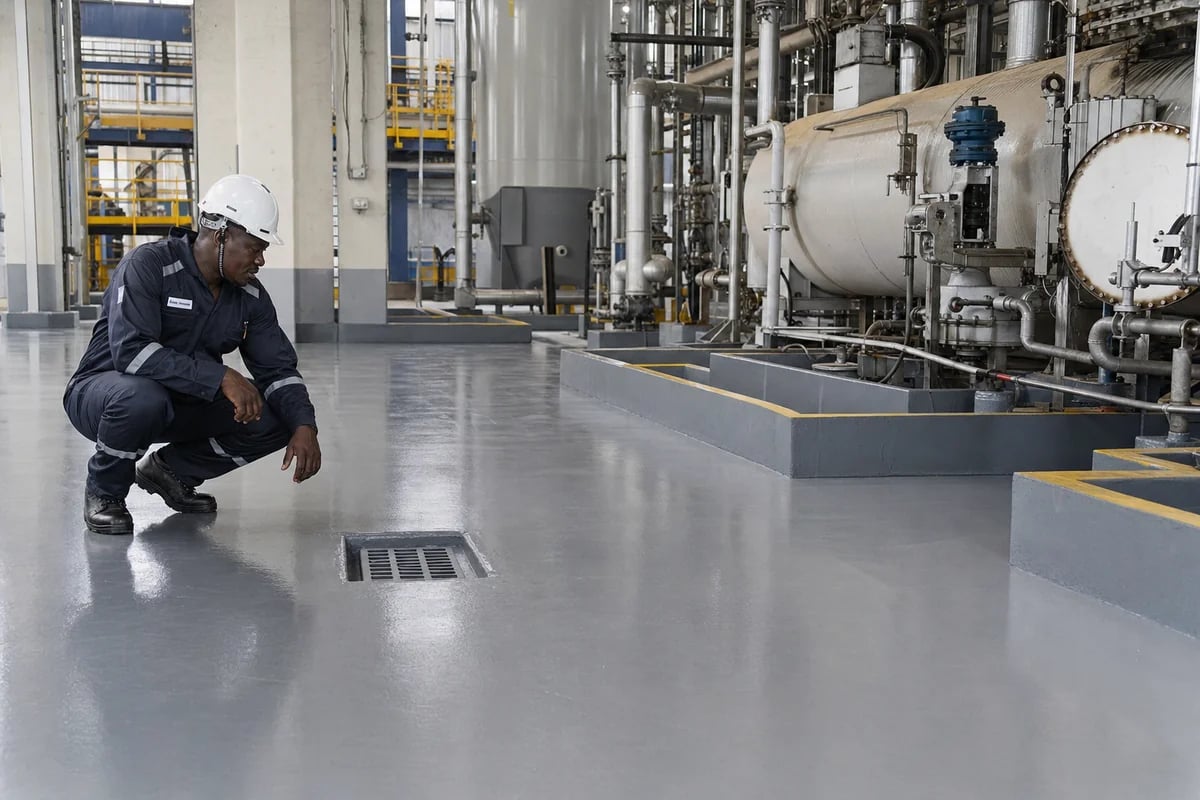
Oil-and-gas downstream operations face hydrocarbon spillage, abrasive solid handling, and explosive-environment classification requiring ATEX-compliant flooring systems.
Our approach
Industrial Floors Ghana delivers oil-and-gas downstream flooring with hydrocarbon-resistant chemistry, ATEX-classified system specification, and full QC documentation.
Industrial Floors Ghana delivers oil-and-gas downstream flooring with hydrocarbon-resistant chemistry, ATEX-classified system specification, and full QC documentation.
The Challenge
Oil-and-gas downstream facilities — fuel depots, tank farms, lubricant blending plants, and marine fuel terminals along Ghana’s Western Region coastline — impose flooring demands that few industrial systems are engineered to withstand. Hydrocarbon spills, fuel permeation, and aggressive chemical wash-down cycles degrade conventional concrete rapidly, creating surface deterioration that escalates from aesthetic nuisance to structural liability within months. In regulated downstream environments, a compromised floor is not a maintenance issue — it is a compliance failure.
The ATEX classification framework adds a further layer of specification rigour. In zones where flammable vapour concentrations reach measurable thresholds, the floor itself must resist electrostatic charge accumulation. A standard epoxy or polyurethane coating, however well applied, does not satisfy this requirement unless it is explicitly formulated and certified to conductive or dissipative classification. Downstream operators who specify non-classified systems expose their facilities to regulatory shutdown risk — and their workforce to conditions that safety auditors regard as unacceptable.
Ghana’s downstream sector has matured significantly across the Takoradi Port corridor and the Tema Oil Refinery zone. Facility standards have converged toward international inspection benchmarks, with local operators and multinational joint-venture partners demanding full QC documentation, third-party-witnessed testing, and traceable material certification for every installed system.
The Industrial Floors Ghana Solution
Since 1975, Industrial Floors Ghana has developed a structured methodology for downstream flooring that begins with site-specific hazard classification and ends with a signed QC documentation package. No system specification is issued without a preliminary assessment of the ATEX zone classification, the chemical exposure profile, and the substrate condition. This sequence — assess, specify, install, document — is the discipline that 51 years of industrial practice has refined into standard operating procedure.
The hydrocarbon-resistant chemistry we specify is drawn from solvent-resistant novolac epoxy systems and polyurethane-modified formulations that resist fuel permeation at the molecular level, not simply at the surface coat. Where ATEX zone classification mandates electrostatic dissipation, our system specification incorporates conductive primer layers, earthing grid integration, and surface resistance testing to IEC 61340-4-1 — all conducted before client sign-off. Laser-measured substrate flatness to DIN 18202 tolerances, ASTM F1869 moisture verification, and compressive strength confirmation precede every installation commencement.
Material + System Specification
- Hydrocarbon-resistant novolac epoxy topping — solvent- and fuel-resistant formulation, 4–6 mm build, resistant to BTEX compound permeation
- ATEX-compliant conductive primer system — earthing grid integration with surface resistance verified to IEC 61340-4-1; suitable for Zone 1 and Zone 2 classification environments
- Polyurethane-modified seal coat — chemical-resistant finish layer, UV-stable, compatible with high-pressure steam and caustic wash-down cycles
- ASTM F1869 calcium chloride moisture testing — conducted at substrate level prior to system application; results documented in client QC file
- DIN 18202 flatness compliance — laser-measured across all working bays; deviation reports issued as part of handover documentation
- Full QC documentation package — material data sheets, batch certificates, moisture test records, surface resistance readings, and installation sign-off protocol
Typical Project Profile
A downstream flooring engagement typically covers 2,000 to 18,000 square metres across fuel dispensing bays, chemical storage zones, loading apron areas, and secondary containment bunds. Installations are phased to allow continuous facility operation where shutdown constraints apply. Project timelines range from six to fourteen weeks depending on substrate remediation requirements and ATEX classification scope. Sectors served include coastal fuel terminal operators, lubricant blending facilities, LPG handling installations, and marine bunkering support yards along the Takoradi and Tema corridors.
Outcomes
- Regulatory compliance confidence — ATEX-classified system specification with documented surface resistance verification, ready for third-party safety audit
- Hydrocarbon permeation resistance — novolac epoxy chemistry withstands sustained fuel and solvent contact without substrate degradation
- Traceable QC documentation — full material certification, moisture test records, and flatness reports issued at handover
- Extended service life — system engineered for decade-scale performance under heavy chemical and mechanical loading
- Reduced operational liability — floor specification eliminates electrostatic ignition risk in classified vapour zones