Food-Grade Flooring
Food-grade PU screed and seamless coved flooring in Tema & Accra — thermal-shock and wash-down tolerant, coved-to-wall with no microbial harbourage, with antimicrobial options and HACCP/GMP hygiene framing, on slabs moisture-tested to ASTM F2170/F1869. Industrial Floors Ghana, since 1975.
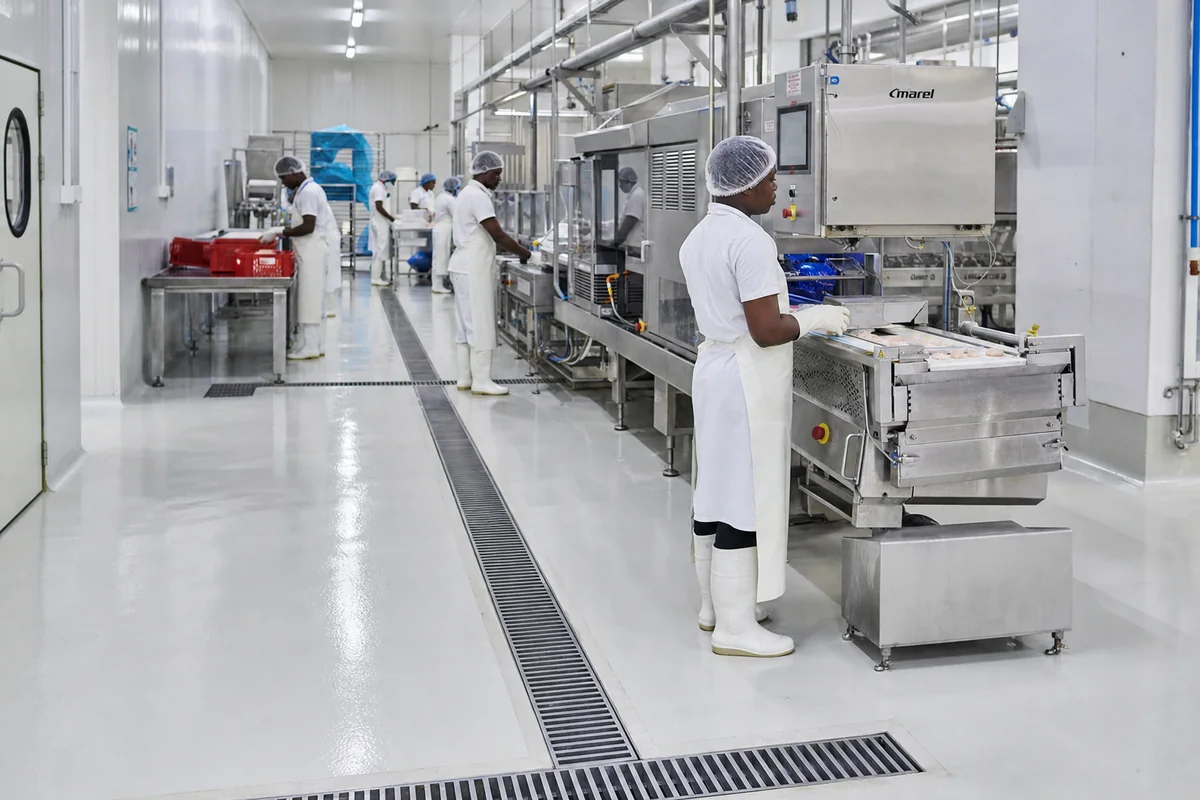
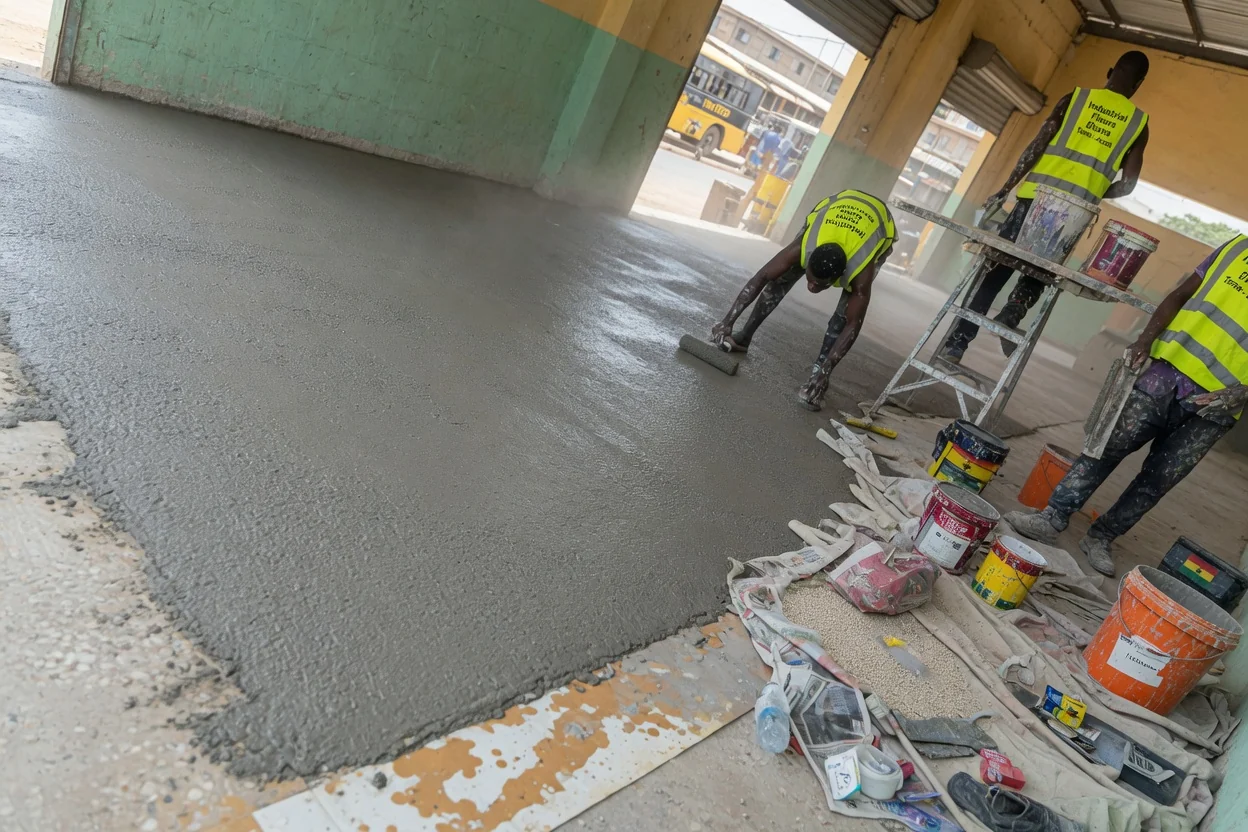
Food-grade flooring is a seamless, non-porous hygienic floor system — usually a polyurethane (PU) screed — laid over a prepared slab with coved-to-wall bases so the production environment washes down as one continuous surface with no joint or corner for bacteria to harbour in. In Ghana’s humidity its success is decided beneath the resin, by slab moisture testing and substrate preparation. Industrial Floors Ghana has installed hygienic food floors across Tema and Accra since 1975.
Why Food Floors Fail Early in Ghana’s Conditions
Two things defeat a food floor in this climate. The first is the slab beneath it: in Ghana’s persistent 81–83% relative humidity, moisture vapour rising through concrete builds osmotic and hydrostatic pressure under a resin layer and lifts it — and in a wash-down environment a lifted edge becomes a bacterial trap overnight. The second is the wrong material: a thin decorative epoxy crazes and debonds under the thermal shock of hot CIP wash-down and steam, then cracks become harbourage.
We engineer against both. Before a drop of resin is mixed we test in-situ relative humidity to ASTM F2170 and moisture-vapour emission to ASTM F1869, prime to the reading, and specify a PU (polyurethane) screed body rated for thermal cycling and aggressive wash-down chemistry rather than a coating that was never meant for a production hall.
Food-Grade Systems We Install in Tema & Accra
Polyurethane (PU) Cementitious Screed
The food-industry workhorse — a thick, monolithic screed that shrugs off hot wash-down, steam, thermal shock and the fats, sugars and organic acids of food and beverage production. Laid seamless and coved, it is the default for processing halls operating under continuous hygiene load.
Seamless Coved-to-Wall Detailing
Integral coves are formed at every floor-to-wall, floor-to-plinth and around every drain and channel, removing the 90° crevice where residue and bacteria collect — so floor and wall clean as one surface and the junction passes audit.
Antimicrobial-Additive Topcoats
Where the zone classification calls for it, an antimicrobial additive is built into the topcoat to suppress microbial growth on the surface between cleans — an option, specified to the zone, not a substitute for hygienic design.
Anti-Slip Hygienic Finishes
Profiled to a target slip rating (EN 16165 ramp method, R10–R13) for wet-process and wash-down areas where safety underfoot is mandatory and a smooth finish would be unsafe.
Standards & Moisture Doctrine
| Standard / control | What it governs | Why it decides the floor |
|---|---|---|
| ASTM F2170 | In-situ relative humidity (probes at 40% slab depth) | The dominant pre-install moisture test; the screed and primer are chosen to this reading |
| ASTM F1869 | Calcium-chloride moisture-vapour emission rate | Surface vapour load; flags slabs needing a vapour-suppression primer before a hygienic floor goes down |
| ICRI CSP | Concrete surface profile after preparation | The mechanical key the screed bonds to — concrete uses ICRI CSP, not the steel-only ISO 8501 |
| EN 16165 (Annex B) | Ramp R-rating for anti-slip | Sets the wet-area slip class (R10–R13) for safe wash-down floors |
| ASTM D3359 | Coating adhesion (cross-cut tape) | Verifies the bond at handover |
| HACCP / GMP | Hygiene management framework | The seamless, coved, non-porous, wash-down-ready surface is specified to support — not certify — the facility’s documented food-safety plan |
How We Install a Food-Grade Floor
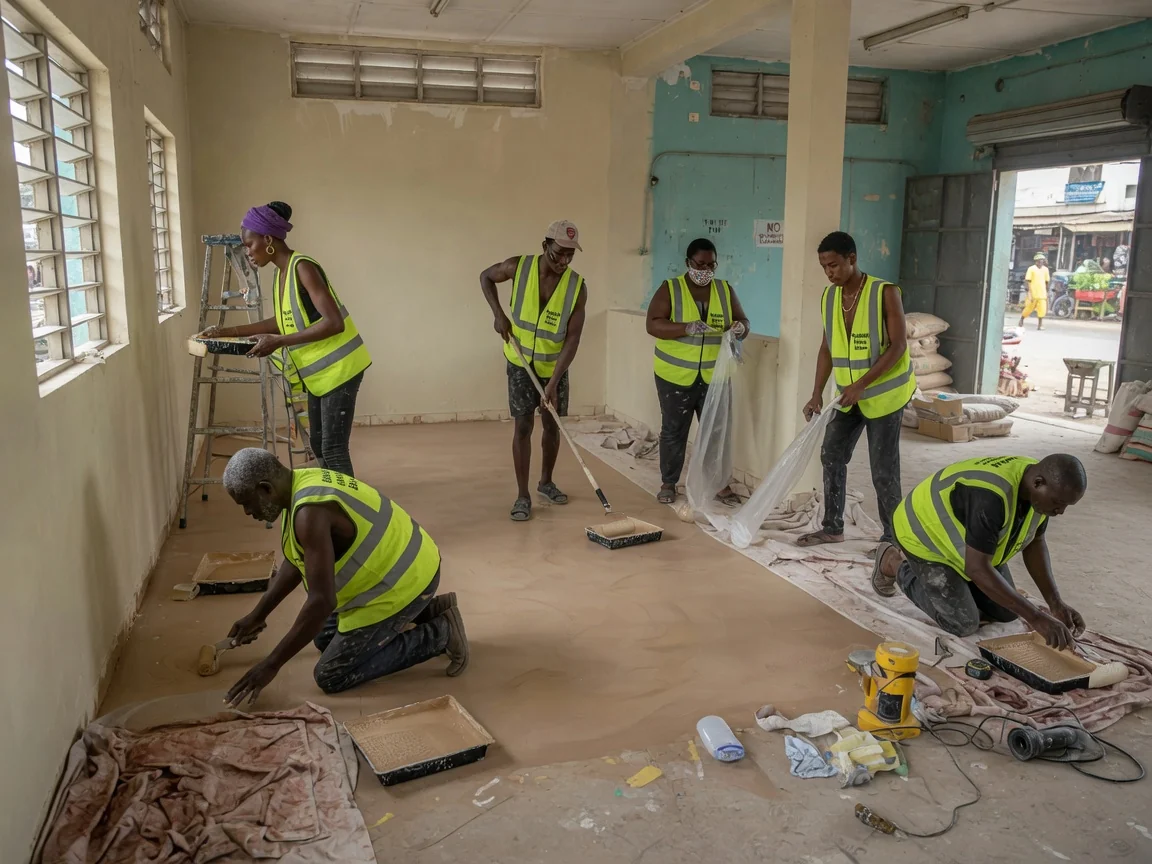
- Slab moisture & substrate testing — ASTM F2170 in-situ RH + ASTM F1869 MVER before anything else.
- Surface preparation — shot-blasting / diamond grinding to the specified ICRI CSP; cracks, joints and fats removed.
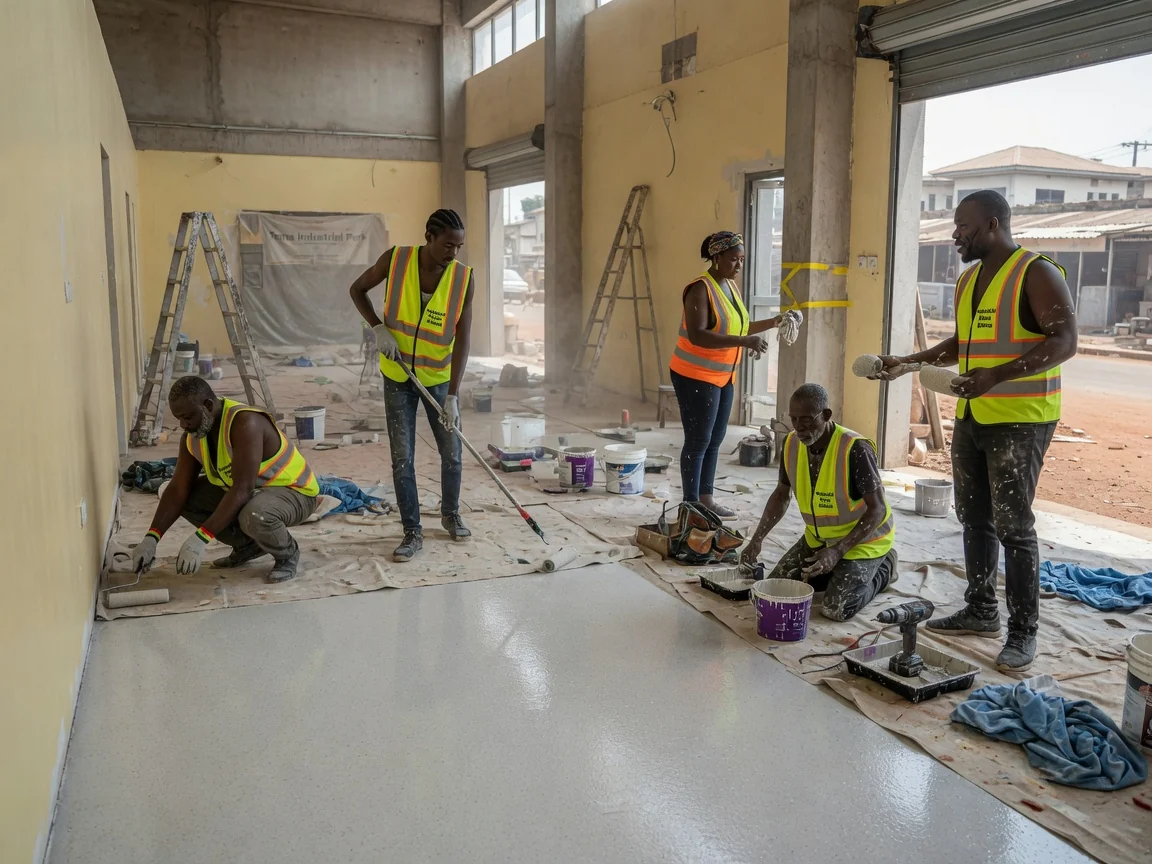
- Priming & PU screed build with coved bases — moisture-tolerant primer to the reading, then a PU screed body laid to thickness with seamless coves at every junction.
- Antimicrobial topcoat & hygiene detailing — antimicrobial-additive topcoat where specified, to the target EN 16165 slip rating; drains and plinths sealed in.
- Verification & handover — adhesion (ASTM D3359), film build, flatness, and a signed QC and documentation package for the audit file.
Comparing Hygienic Floor Systems for Ghana’s Climate
| System | Best for | Wash-down / thermal shock | Lifespan |
|---|---|---|---|
| PU cementitious screed | Food, beverage, dairy processing halls | Highest — hot CIP, steam, thermal cycling | 15–20 yrs |
| Antimicrobial PU/epoxy topcoat | Zones needing surface microbial control | High when over a PU/epoxy body | Per system |
| Self-levelling epoxy | Dry packaging, ambient food handling | Moderate — not for severe hot wash-down | 10–15+ yrs |
| Standard decorative epoxy | Not recommended for wet food production | Low — crazes under thermal shock | Short in this duty |
What Affects the Cost
- The screed system and thickness specified (PU screed body, topcoat, antimicrobial additive)
- Coving, drain, channel and plinth detailing across the production zone
- Slab condition and any moisture remediation or crack/joint repair required
- Slip rating (EN 16165) and hygiene classification of each zone
- Area (m²), access, and whether the facility stays operational during works
Every quote follows a site survey and slab moisture test — no fixed rate is given before the slab is tested.
Applications Across Ghana
- Meat, fish and poultry processing halls and wash-down corridors
- Dairy, cheese and beverage bottling and filling rooms across the Spintex food-processing belt
- Commercial bakeries, confectionery and high-throughput packaging halls
- Pharmaceutical and nutraceutical production requiring seamless, coved, GMP-aligned floors
- Cold-room access corridors and agro-processing parks across Tema and inland Ghana
Areas We Serve
Industrial Floors Ghana installs food-grade flooring throughout the Tema industrial area, Spintex, North Industrial Area, and Greater Accra, as well as Kumasi and Takoradi.
Related Services
- Industrial Epoxy Floors — seamless resin systems for production and FMCG
- Chemical-Resistant Coatings — for processing and bunded areas
- Anti-Static Flooring — ESD systems for pharma and electronics
- Warehouse Floors — heavy-traffic systems for storage and distribution
Frequently Asked Questions
What is the best floor for a food-processing facility in Ghana? A polyurethane (PU) screed laid seamless with coved-to-wall bases over a moisture-tested, ICRI-CSP-prepared slab. PU screed tolerates thermal shock from steam and hot wash-down and resists the fats, sugars and organic acids of food and beverage production far better than a standard epoxy — which is why it is the food-industry default.
Why do coved bases matter for HACCP and GMP? A square floor-to-wall junction is a 90° crevice where residue and water collect and bacteria colonise — and it fails inspection. A seamless cove removes that junction so floor and wall wash down as one continuous, non-porous surface, exactly what a HACCP or GMP hygiene framework expects.
Can the floor handle hot wash-down and steam cleaning? Yes — that is what PU screed is engineered for. Unlike thin epoxy, which can craze or debond under repeated thermal shock, a correctly specified PU screed tolerates hot CIP wash-down, steam and rapid temperature swings across the production lifecycle.
How much does a food-grade floor cost? It is quoted on survey — cost varies with screed thickness, the antimicrobial and slip specification, slab condition and moisture remediation, coving and drain detailing, area, and access. We never give a fixed rate before testing the slab; request a site survey.