The problem
Electronics manufacturing requires ESD-controlled flooring with documented IEC 61340-5-1 compliance — measured surface resistance 10⁶-10⁹ Ω with full grounding network.
Our approach
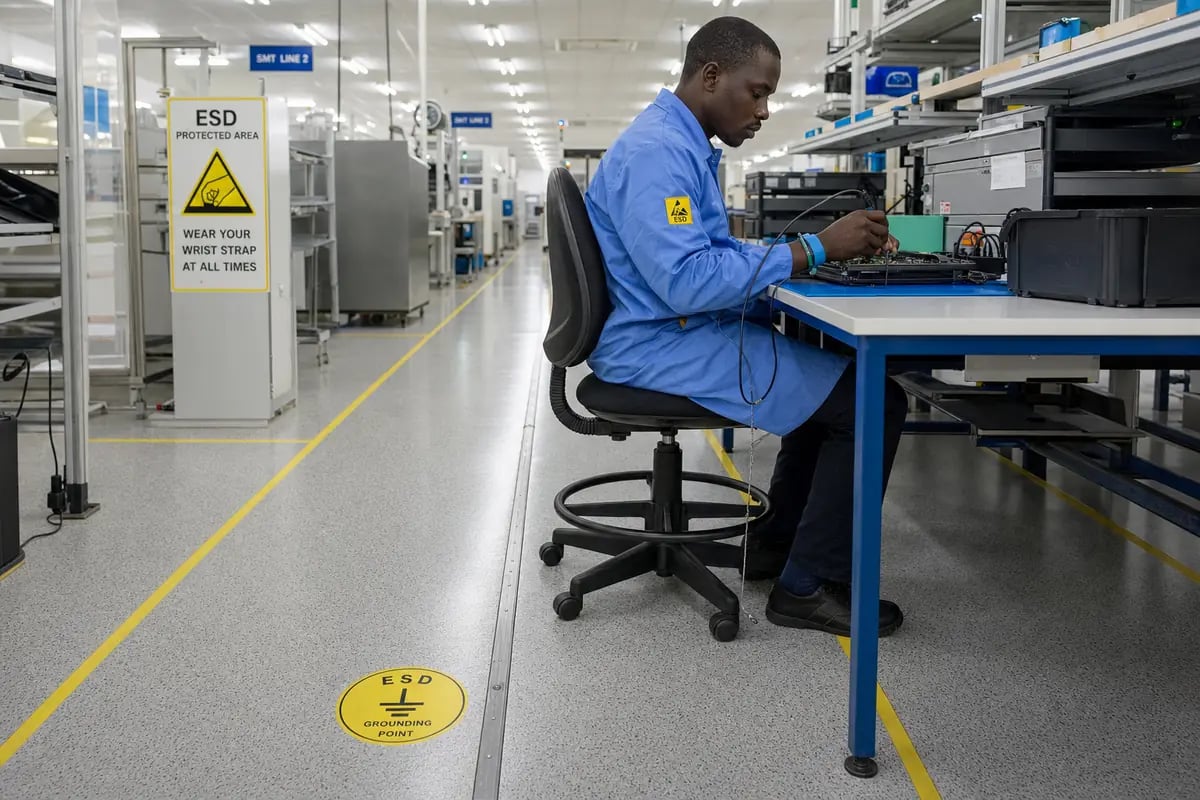
Industrial Floors Ghana delivers IEC 61340-5-1 compliant ESD systems with copper grounding network, conductive primer, and continuity-tested topcoat for electronics manufacturing facilities.
Industrial Floors Ghana delivers IEC 61340-5-1 compliant ESD systems with copper grounding network, conductive primer, and continuity-tested topcoat for electronics manufacturing facilities.
The Challenge
Electronics manufacturing and semiconductor assembly environments operate under a class of failure risk that no other industrial sector matches. Electrostatic discharge — measured in nanoseconds, invisible to the floor supervisor — can destroy a microcontroller, corrupt a memory array, or trigger a catastrophic yield loss across an entire production run. In Ghana’s growing Airport City and Tema Free Zones electronics assembly corridor, facility managers increasingly specify to IEC 61340-5-1 as the minimum acceptable standard for floor systems in ESD-sensitive zones. Meeting that standard is not a surface treatment exercise. It is a structural electrical engineering challenge.
Concrete substrates in Ghana’s industrial zones carry particular complexity: high ambient humidity, variable slab moisture readings, and the thermal cycling of West African climates all affect the long-term continuity of a conductive floor system. A system that passes continuity testing at installation and fails within eighteen months — due to delamination, moisture vapour transmission, or inadequate grounding topology — is a documented liability, not a solution. The sector demands accountability through ongoing measurable performance, not a single commissioning certificate.
The consequence of specifying below standard is measurable in monetary terms. A single ESD event in a cleanroom-adjacent assembly bay can trigger component losses, production halts, and regulatory non-compliance events that dwarf the capital cost of the floor itself. Facilities operating to ISO Class 7 and Class 8 standards have zero tolerance for a floor system that was not engineered from substrate to topcoat as a unified electrical system.
The Industrial Floors Ghana Solution
Industrial Floors Ghana approaches ESD flooring as a precision electrical installation, not a coating application. Our methodology begins at slab level with ASTM F1869 moisture vapour emission testing — a non-negotiable step that determines primer selection and application protocol before any conductive layer is introduced. Where readings exceed acceptable thresholds, a vapour-suppression barrier is installed ahead of the copper grounding network, ensuring the system’s electrical integrity is protected against Ghana’s humidity variables for the operational life of the facility.
The copper grounding network is laid in a grid topology calculated to the facility’s zone geometry, bonded to the building’s earthing system and documented in as-built drawings signed by our technical team. Conductive primer is applied over the prepared substrate as a continuous conductive layer, followed by a specification-grade ESD topcoat formulated for the floor’s mechanical duty cycle — whether light-traffic cleanroom aisles or heavier industrial assembly zones. Each completed zone undergoes continuity testing with results recorded in a client-issued compliance dossier.
Founded in 1975 and carrying 51 years of industrial track record across Ghana’s manufacturing sector, our team has delivered ESD systems to electronics assembly facilities, instrument calibration laboratories, and defence electronics environments where specification tolerance is absolute.
Material + System Specification
- IEC 61340-5-1 compliance — system-level resistance to ground: 1 × 10⁴ Ω to 1 × 10⁹ Ω
- ASTM F1869 moisture vapour emission testing prior to primer application — documented per zone
- Copper grounding grid — laid to facility zone geometry, bonded to building earth, as-built drawings issued
- Conductive epoxy primer — continuous conductive layer bridging substrate to topcoat
- ESD-grade topcoat — formulated for mechanical duty cycle, available in light-traffic cleanroom and heavy industrial variants
- Post-installation continuity testing — point-to-point and resistance-to-ground measurements issued in compliance dossier
Typical Project Profile
A representative engagement covers an electronics assembly facility of 1,200 to 6,000 square metres across multiple ESD-controlled zones, typically within Tema Free Zones Enclave or Airport City Accra. Project duration runs from three to seven weeks depending on zone phasing requirements and existing production schedules. Sectors served include semiconductor assembly, PCB manufacturing, instrument and avionics calibration workshops, and defence electronics integration facilities. Phased installation protocols are available to maintain partial production continuity during floor works.
Outcomes
- IEC 61340-5-1 compliant floor system with documented resistance values per zone
- Copper grounding network as-built drawings issued for facility compliance records
- Continuity test certificates per zone — client-ready for regulatory and insurance audit
- Reduced ESD-related yield loss risk across assembly and calibration production environments
- Floor system engineered for Ghana’s ambient humidity and thermal conditions — not a temperate-climate specification applied without adaptation