Loading Dock Surfaces
Impact-, abrasion- and anti-slip-resistant loading dock surfaces in Tema & Accra — armoured joint-edge nosings, cementitious-PU and broadcast systems for dock levellers, transitions and exterior aprons, rated to EN 16165 (R9–R13) and built over a moisture-tested (ASTM F2170/F1869) slab. Industrial Floors Ghana, since 1975.
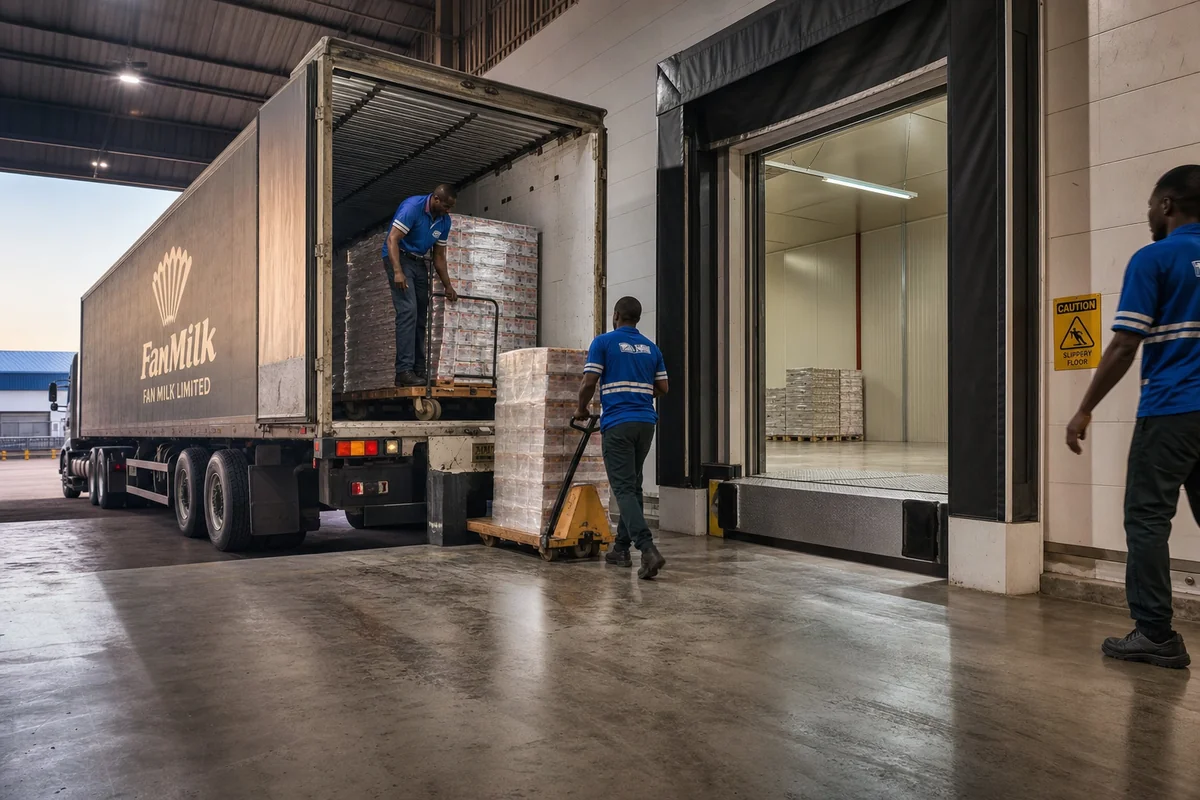
Loading dock surfaces are impact-, abrasion- and anti-slip-resistant systems built at the transition between building slab and logistics traffic — where trucks reverse under load, trailers flex against levellers, and fork-tines strike the edge. They use armoured joint-edge nosings and high-build toppings to survive forces a general slab cannot. Industrial Floors Ghana has engineered loading dock surfaces across Tema and Accra since 1975.
Why Loading Docks Fail in Ghana’s Conditions — and How We Prevent It
The dock fails first for two reasons. Mechanically, it is the worst-loaded zone in the building: laden trucks reverse onto it, trailer beds flex against the leveller, and fork-tines strike the joint edge at oblique angles thousands of times a week, breaking down unprotected joints and spalling the surface. Environmentally, the exterior apron faces UV, thermal cycling and driving rain — and underneath all of it sits the same slab-moisture risk that lifts any resin floor in Ghana’s persistent 81–83% relative humidity.
We engineer against both vectors. Joint edges are armoured and cast monolithic so impact has nothing to break out; the slab is moisture-tested to ASTM F2170 and ASTM F1869 before any topping is placed; and the dock approach and exterior apron are finished with an anti-slip aggregate rated to EN 16165 so the surface stays safe wet or dry.
Loading Dock Systems We Install in Tema & Accra
Cementitious-Polyurethane Dock Topping
A high-build, impact- and abrasion-resistant topping for the dock floor and leveller pockets, tolerant of thermal shock, wash-down and the rolling impact of laden traffic.
Armoured Joint-Edge Nosings
Steel or cast-iron edge profiles cast monolithic into the topping at leveller pockets and transitions — the detail that stops the progressive joint-edge spalling which forces repeat dock repairs.
Anti-Slip Dock Approach & Apron
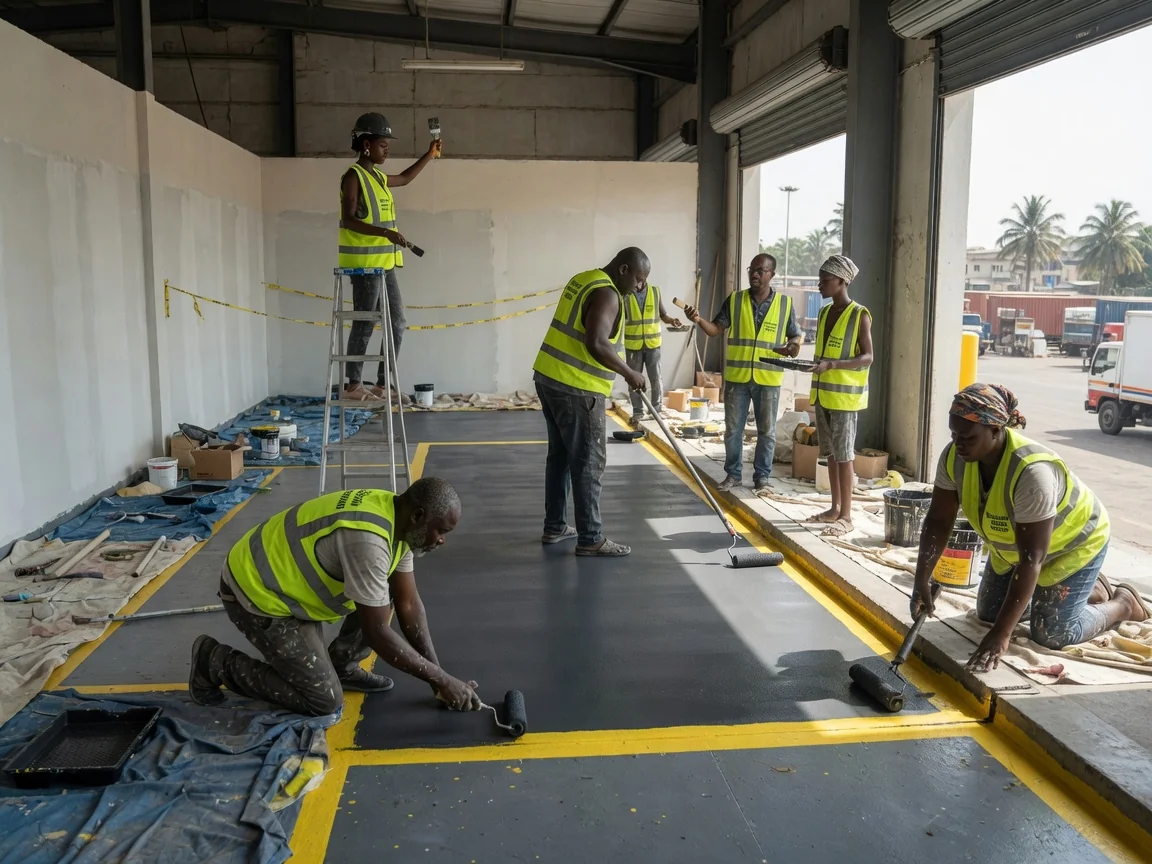
Broadcast-aggregate finishes specified to a target EN 16165 ramp rating (R9–R13) for the dock approach, ramp and exterior apron, where wet tyres and foot traffic make slip the governing risk.
Exterior Apron & Transition Surfaces
UV-stable, moisture-vapour-tolerant systems for the open apron and the dock-to-yard transition, detailed against thermal cycling and driving rain at the building opening.

Dock Surface Standards We Build To
| Standard | What it governs | Why it decides the surface |
|---|---|---|
| EN 16165 (Annex B) | Ramp anti-slip rating R9–R13 | The slip rating for dock approach, ramp and exterior apron — replaces the superseded DIN 51130 |
| ASTM D4060 / C779 | Abrasion / wear resistance | The dock takes concentrated rolling and fork-tine abrasion; the topping is specified to a wear grade |
| ICRI CSP | Concrete surface profile after preparation | The mechanical key the overlay bonds to — concrete uses ICRI CSP, not the steel-only ISO 8501 |
| ASTM F2170 / F1869 | In-situ slab RH / moisture-vapour emission | Trapped moisture lifts a dock topping just as it lifts any resin floor — tested first |
| ASTM D3359 | Coating adhesion (cross-hatch tape) | Confirms the overlay is bonded before sign-off |
How We Install a Loading Dock Surface
- Load mapping & slip specification — convert vehicle class, axle loads and cycle counts into a load case; fix the EN 16165 (R9–R13) anti-slip target.
- Slab moisture & substrate testing — ASTM F2170 in-situ RH + ASTM F1869 MVER, plus compressive-strength coring of the existing slab.
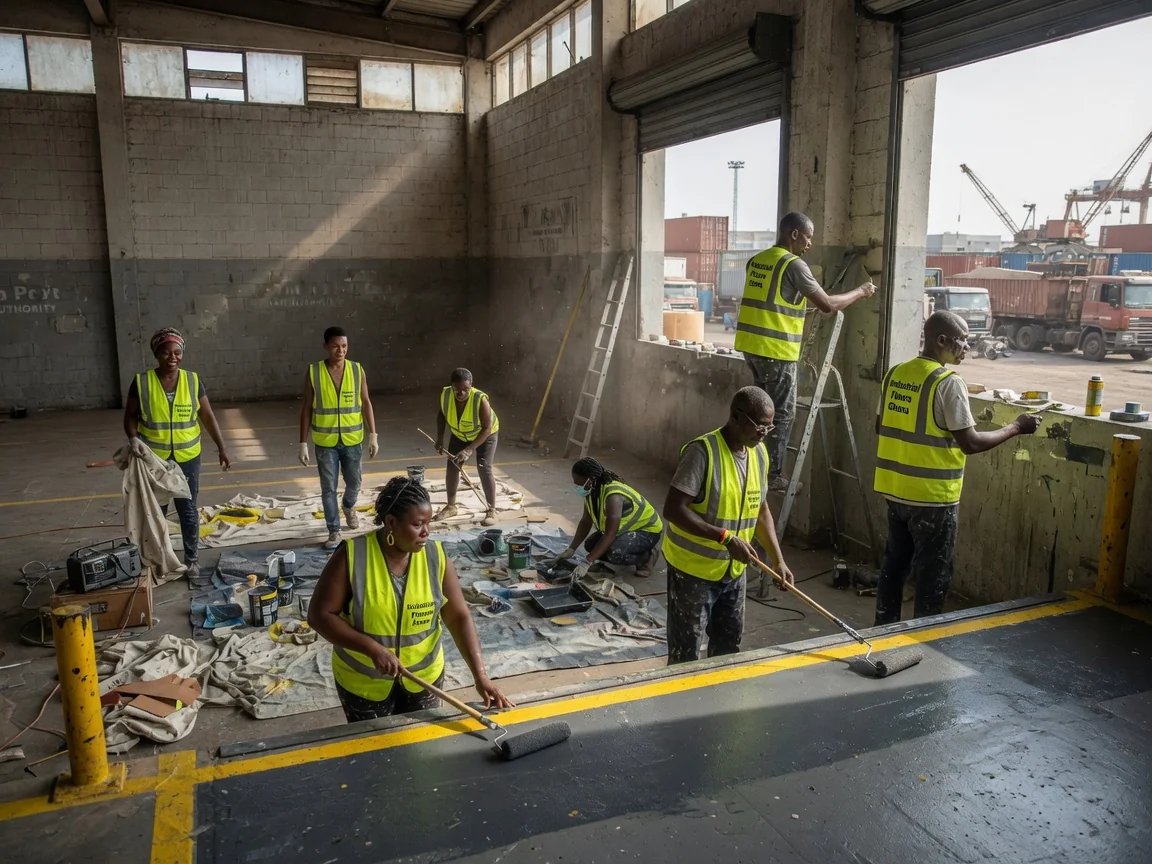
- Surface preparation & joint detailing — remove deteriorated concrete to sound substrate, shot-blast to ICRI CSP, set armoured nosings to line and level.
- Impact-grade overlay & anti-slip — high-build cementitious-PU or broadcast system at the correct thickness; anti-slip aggregate on the approach and apron.
- Verification & handover — flatness, anti-slip finish, adhesion (ASTM D3359), abrasion grade (ASTM D4060/C779), signed QC report.
Comparing Loading Dock Systems for Ghana’s Climate
| System | Best for | Strength | Exterior tolerance |
|---|---|---|---|
| Cementitious-PU topping | Interior docks, leveller pockets, wash-down | Highest impact & thermal shock | High |
| Broadcast / aggregate dock floor | Forklift-traffic dock floors | High abrasion & impact | Moderate |
| Anti-slip apron broadcast | Exterior aprons, ramps, approaches | Slip safety (EN 16165 R-rating) | Highest — UV-stable |
| Armoured-nosing detail | All leveller pockets & transitions | Stops joint-edge spalling | N/A — edge protection |
What Affects the Cost
- The system specified (cementitious-PU, broadcast, anti-slip apron) and its build thickness
- The extent of armoured joint-edge nosings and leveller-pocket / transition detailing
- Slab condition and any moisture remediation or structural repair required
- Area (m²), access, and whether the dock stays operational during works
- The EN 16165 anti-slip rating and abrasion grade specified for each zone
Every quote follows a site survey, a slab moisture test, and a dock-condition assessment — no fixed rate is given before the slab is tested.
Applications Across Ghana
- FMCG and beverage distribution dock floors across the Tema industrial area and Spintex
- Pharmaceutical and cold-chain logistics docks requiring hygienic, anti-slip transitions
- Steel, cement and container-freight yards at port-adjacent warehouses
- General manufacturing and 3PL distribution docks across Greater Accra
- Logistics facilities in Takoradi
Areas We Serve
Industrial Floors Ghana installs loading dock surfaces across the Tema industrial area, Spintex, North Industrial Area, and Greater Accra, and out to Kumasi and Takoradi.
Related Services
- Warehouse Floors — heavy-traffic systems for the slab the dock connects to
- Heavy-Traffic Flooring — for forklift and high-load circulation
- Industrial Epoxy Floors — seamless resin systems for production areas
- Polished Concrete — durable, low-maintenance internal slabs
Frequently Asked Questions
Why do loading docks fail faster than the rest of the floor? Because the dock is the worst-loaded zone in the building. Laden trucks reverse onto it, trailer beds flex against the leveller, and fork-tines strike the edge at oblique angles thousands of times a week — concentrated impact and abrasion a general slab is not designed to take. We armour the joint edges, build an impact-grade overlay, and detail the leveller and transition joints so the breakdown cycle stops.
What anti-slip rating should a loading dock have? The dock approach, leveller and exterior apron should be specified to EN 16165 (R9–R13 ramp method) according to how wet and contaminated the surface gets — exterior aprons exposed to rain typically need a higher R-rating than a covered internal dock. We broadcast anti-slip aggregate to hit the target rating where it is needed.
How are exterior dock aprons protected from sun and rain in Ghana? Exterior aprons face UV, thermal cycling and driving rain on top of the mechanical load. We specify UV-stable, moisture-vapour-tolerant binders, armoured joint-edge nosings to stop spalling, and an anti-slip broadcast rated to EN 16165 — over a slab moisture-tested to ASTM F2170/F1869 first.
How much does a loading dock surface cost? It is quoted on survey — cost varies with the system, the extent of armoured nosings and joint detailing, slab condition and moisture remediation, area, and access. We never give a fixed rate before testing the slab and surveying the dock; request a site survey.