Le problème
Multi-shift operations with aggressive wash-down cycles face combined chemical-mechanical stress that destroys conventional flooring within months.
Notre approche
Industrial Floors Ghana installs multi-shift wash-down-resistant systems with polyurethane topcoat and integrated drainage falls — engineered for 15+ year service life under continuous wash-down operations.
Industrial Floors Ghana installs multi-shift wash-down-resistant systems with polyurethane topcoat and integrated drainage falls — engineered for 15+ year service life under continuous wash-down operations.
The Challenge
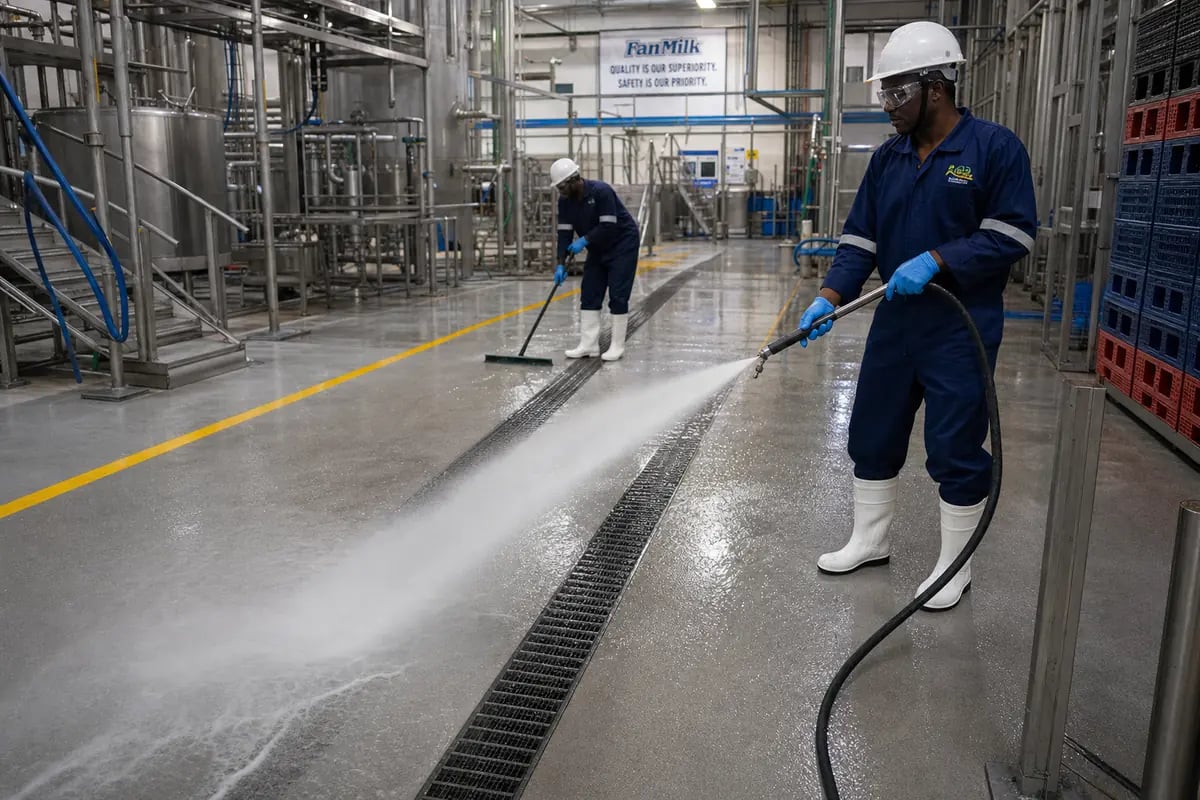
Fast-moving consumer goods facilities along the Spintex corridor and Tema Industrial Zone operate under a production logic that tolerates almost no downtime. Lines run across multiple shifts, sanitation crews follow immediately behind production, and hygiene-protocol wash-downs occur with high-pressure water and caustic cleaning agents — sometimes three or four times within a single 24-hour cycle. The floor is not incidental to this cycle; it is load-bearing infrastructure for the entire sanitation system.
Standard industrial concrete, left unsealed or finished with a lightweight coating, degrades rapidly under this regime. Repeated chemical exposure breaks down the cement matrix, surface carbonation accelerates, and standing water migrates into microcracks. Within 18 to 24 months, a facility manager is contending with delamination, bacterial harbouring in joint failures, and surface cratering that creates hygiene non-compliance — not a maintenance issue but a production liability.
Ghana’s food-grade and FMCG manufacturing sector demands a floor system engineered from substrate to topcoat specifically for continuous wet-environment service. That specification begins with moisture management, continues through chemical-resistant build coats, and concludes with a topcoat formulation matched to the cleaning agents the facility actually uses.
The Industrial Floors Ghana Solution
Industrial Floors Ghana has engineered and installed wash-down-resistant floor systems since 1975. In multi-shift FMCG environments, our installation sequence begins with ASTM F1869 moisture vapour emission testing on the substrate — a step that is non-negotiable before any chemical coating is committed. Substrates failing moisture thresholds are mechanically prepared and primed with a vapour-suppressive epoxy layer before the build system commences.
The primary build coat is a high-build solvent-free epoxy system applied at 2–3 mm to achieve joint-bridging thickness and chemical barrier performance. The topcoat is a food-safe aromatic-free polyurethane finish, selected for resistance to the caustic concentrations common to CIP (Clean-in-Place) wash-down regimes and certified for food-contact zone application. Drainage falls are integrated into the specification from the design stage — not added retrospectively — with laser-confirmed fall gradients directing wash-down water to designated drainage channels without pooling.
The completed system is tested for hardness, adhesion, and chemical resistance before handover. A signed flatness and installation report is issued to the facilities team, consistent with our founding commitment: built to FM2 — measured, certified, signed.
Material + System Specification
- Substrate preparation: Mechanical diamond-grinding to CSP 3–4 profile; ASTM F1869 MVER testing prior to coating commitment
- Vapour management: Solvent-free epoxy vapour suppressant primer at 100–150 µm DFT where MVER exceeds 3 lb/1,000 ft²/24 hr
- Build coat: High-build solvent-free epoxy at 2–3 mm, with integral aggregate broadcast for slip-resistance in wet zones
- Topcoat: Food-safe aromatic-free aliphatic polyurethane at 80–120 µm DFT; caustic-wash rated to NaOH 10% and HNO₃ 5%
- Drainage falls: Laser-confirmed fall gradients at 1:80 to 1:100, engineered and installed prior to topcoat to eliminate pooling under wash-down
- Joint treatment: Semi-flexible polyurethane sealant at construction joints rated for thermal cycling in CIP-temperature environments
Typical Project Profile
A representative installation covers 2,000–8,000 m² of production floor and wash-down zone across a food-grade or FMCG manufacturing facility in Tema Industrial, Spintex, or Accra’s light-industrial corridors. Project duration runs 10 to 18 working days depending on shift-access windows and substrate condition. Sectors routinely specified include beverage manufacturing, processed-food packaging, personal care manufacturing, and pharmaceutical secondary processing.
Outcomes
- Verified wash-down resistance to caustic and acid cleaning agents used in CIP food-grade regimes
- Integrated drainage falls eliminating standing water — a primary driver of slip incidents and bacterial build-up in production zones
- Documented 15-plus year service life under continuous multi-shift wash-down conditions
- Hygiene-compliant surface free of microcracks, joint failures, and carbonation-related harbourage points
- Signed installation and flatness report issued at project handover — FM2-grade documentation for facilities and compliance records