Le problème
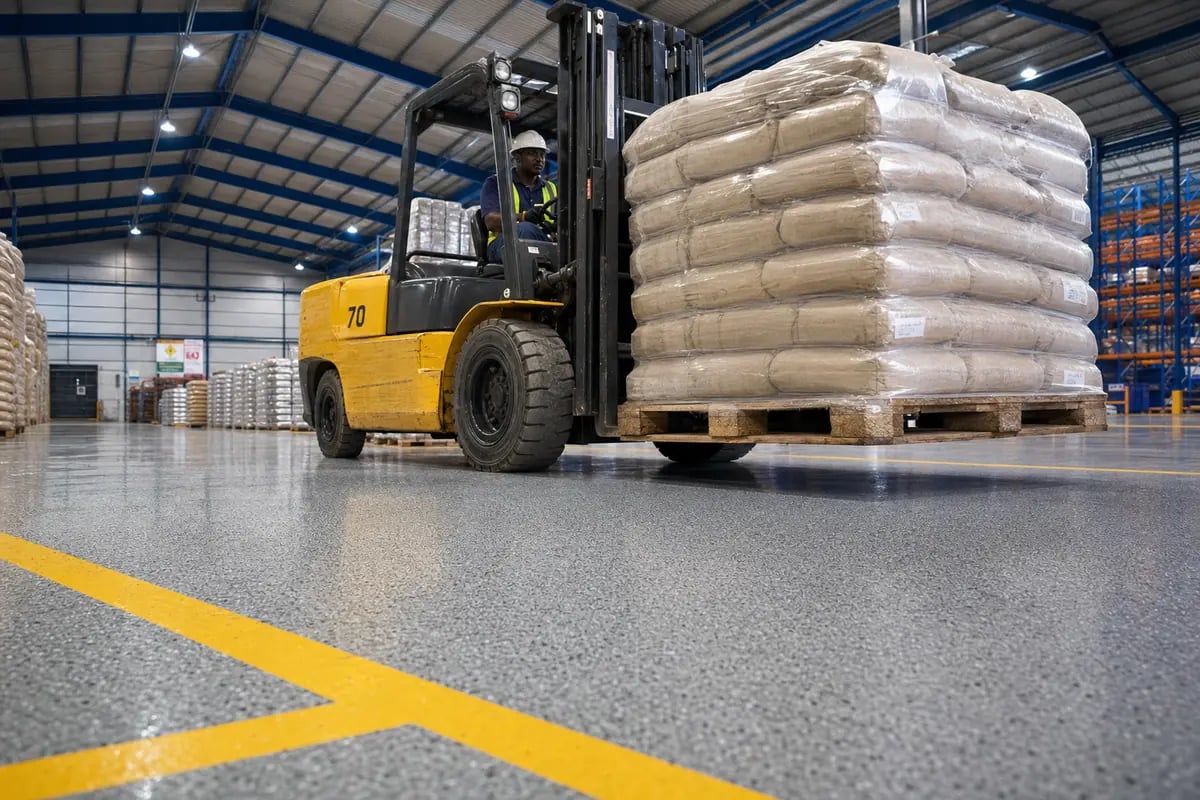
Port-adjacent logistics warehouses face sustained 10-tonne forklift traffic plus chemical exposure from spillage — conventional flooring fails within months without specification-grade engineering.
Notre approche
Industrial Floors Ghana installs heavy-load industrial flooring with polyurethane topcoat over FF50+ self-levelling substrate or diamond-polished concrete — engineered for 10-tonne forklift loads and 15+ year service life.
Industrial Floors Ghana installs heavy-load industrial flooring with polyurethane topcoat over FF50+ self-levelling substrate or diamond-polished concrete — engineered for 10-tonne forklift loads and 15+ year service life.
The Challenge
Logistics and warehousing facilities in Ghana’s industrial corridors — from the Tema Free Zones Enclave to the heavy industrial precincts along the N1 — are operating under load conditions that expose the limitations of conventional concrete slabs within the first years of service. Forklift fleets cycling on 10-tonne axle loads, high-frequency pallet-jack traffic, and the thermal cycling of cold storage bays introduce compressive stress patterns that under-specified floors simply cannot absorb without cracking, delamination, or surface dusting.
The consequences are measurable and costly. Surface degradation generates particulate contamination — a critical concern in food-grade and pharmaceutical-adjacent warehouses. Uneven substrate profiles introduce forklift instability, drive up vehicle maintenance costs, and compromise racking alignment tolerances in high-bay configurations. In a distribution environment operating six days a week across two shifts, floor failure is not a maintenance issue — it is a throughput crisis.
Ghana’s warehouse and logistics sector has matured rapidly, and so have the performance expectations of multinational occupiers, bonded warehouse operators, and pharmaceutical distributors commissioning new facilities. The floor specification can no longer be an afterthought. It must be engineered from the substrate up, with flatness measurements, moisture control, and surface durability treated as non-negotiable design parameters.
The Industrial Floors Ghana Solution
Founded in 1975, Industrial Floors Ghana brings 51 years of floor engineering practice to heavy-load warehouse specifications. The methodology begins with ASTM F1869 moisture testing of the subfloor, establishing the vapour emission baseline before any topping system is committed. Where moisture readings exceed system tolerances, a specialist vapour barrier membrane is incorporated into the build-up — a step frequently omitted by generalist contractors and routinely responsible for topping failure within 24 months of installation.
The structural substrate is placed as a power-floated, FF50+ self-levelling concrete slab, laser-screed to DIN 18202 flatness tolerances. Where maximum floor flatness is critical to high-bay racking operations, the slab is brought to FM2 superflat specification — laser-measured, flatness-reported, and formally certified before the topping coat is applied. The system is closed with a two-component polyurethane topcoat rated for heavy-wheeled traffic, chemical resistance, and impact load — delivering the 15-year service life that institutional occupiers require in their long-form leases.
Material + System Specification
- Substrate: Power-floated concrete slab, FF50+ flatness rating, laser-screed placed to DIN 18202 tolerance — FM2 superflat where high-bay racking is specified
- Moisture control: ASTM F1869 vapour emission testing prior to topping application; specialist vapour barrier membrane incorporated where readings exceed threshold
- Wearing course: Two-component polyurethane topcoat, heavy-duty wheeled-traffic grade, rated for 10-tonne forklift axle loads and high-frequency pallet-jack cycling
- Joint treatment: Armoured movement joints at all construction joint locations; semi-rigid polyurea joint filler in trafficked bays to prevent edge spalling
- Flatness documentation: Laser-measured flatness survey issued on completion; FM2 / FM3 superflat certificate signed and registered to project record
- Finish options: Safety-demarcation line-marking in traffic-aisle and pedestrian-zone layouts; anti-static topcoat available for logistics facilities handling electronics or fuel-adjacent goods
Typical Project Profile
A representative engagement covers 3,000–25,000 m² of warehouse or distribution floor area, delivered in phased bay sections to allow concurrent structural works without full-facility shutdown. Project timelines range from six to sixteen weeks depending on total area and bay sequencing. Sectors served include bonded and general warehousing, cold storage and controlled-environment logistics, food-grade distribution, pharmaceutical warehousing, and automotive parts distribution — any facility where forklift intensity and long-term occupier commitments justify specification-grade floor engineering from the outset.
Outcomes
- Forklift-rated surface integrity sustained across 10-tonne axle loads with no delamination or surface dusting over the rated service life
- FM2 flatness certification with laser-measured flatness report — a documentable specification asset for institutional lease agreements and occupier handovers
- 15+ year service life under normal operational loading, reducing lifecycle floor replacement costs against under-specified alternatives
- Particulate contamination control — sealed, dust-free surface meeting food-grade and pharmaceutical-adjacent hygiene requirements
- Racking alignment confidence — superflat substrate tolerances that support high-bay racking installation without shimming or corrective levelling works