Le problème
FMCG production operators face round-the-clock production line demands with sanitation cycles, fork-tine impact, and continuous foot-traffic — flooring must absorb the abuse without compromising line uptime.
Notre approche
Industrial Floors Ghana installs FMCG production-line flooring through phased multi-shift coordination — fast-cure systems, scheduled-shutdown windows, full documentation for FMCG quality-management audits.
Industrial Floors Ghana installs FMCG production-line flooring through phased multi-shift coordination — fast-cure systems, scheduled-shutdown windows, full documentation for FMCG quality-management audits.
The Challenge
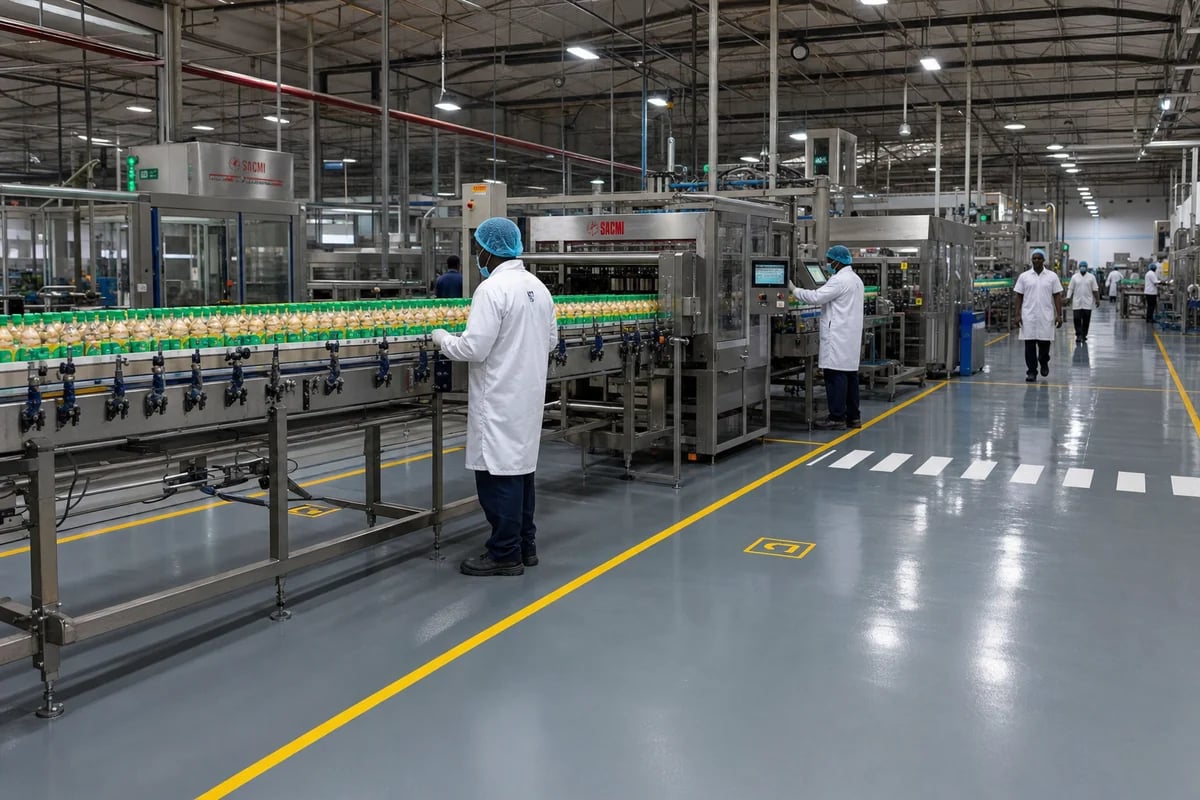
FMCG production lines operate on compressed schedules. A biscuit-sealing line, a bottling carousel, a detergent-filling station — each runs two or three shifts, and the floor beneath it carries chemical spills, hydraulic wash-downs, pallet-jack traffic, and forklift wheel loads simultaneously. When that floor begins to fail — joint cracking, surface delamination, pooling in drainage channels — the facility manager faces a choice that has no clean answer: shut down production to repair, or run on a deteriorating substrate until the floor fails catastrophically.
In the FMCG sector, both options carry cost. An unscheduled shutdown triggers line-fill delays, batch-record gaps, and retailer penalty clauses. A deferred repair compounds substrate damage, extends eventual remediation scope, and introduces hygiene non-conformances that appear in quality-management audits. The floor is not peripheral infrastructure — it is a production-critical surface that food safety auditors, certification bodies, and insurance underwriters inspect and document.
Ghana’s FMCG manufacturing corridor — Spintex Road, Tema Industrial, Accra Plains — presents additional constraints: ambient humidity, aggressive cleaning-chemical cycles, and substrate conditions that vary significantly across aged facilities. These factors demand a flooring methodology calibrated precisely to production continuity, not simply to specification sheets.
The Industrial Floors Ghana Solution
Industrial Floors Ghana coordinates FMCG production-line flooring through phased, multi-shift sequencing — a protocol refined across 51 years of industrial practice. Rather than requiring a full-facility shutdown, the team divides the production floor into defined work zones, sequencing installation to match the client’s shift rotation. While one zone is being prepared and coated, adjacent lines continue operating. Handover of each zone follows a documented curing window, verified against ambient temperature and humidity readings before the line resumes load.
System selection for FMCG environments prioritises fast-cure chemistries — typically moisture-tolerant polyurethane broadcast systems or high-build epoxy with anti-slip aggregate — chosen for return-to-service timelines compatible with a single shutdown window between shifts. Drainage channel reinstatement, joint-filling with chemical-resistant sealant, and coving at wall junctions are executed within the same phased programme. Every installation produces a material data file, substrate moisture record per ASTM F1869, and flatness survey per DIN 18202 — documentation formatted for direct insertion into the facility’s quality-management system.
Material + System Specification
- Fast-cure polyurethane broadcast system — return-to-light-traffic within 6–8 hours; resists cleaning acids, caustic wash-down solutions, and food-grade lubricants
- High-build epoxy topping (2–3 mm) — suitable for dry FMCG production; chemical-resistant, seamless, aggregate-textured to R11/R12 slip resistance
- Chemical-resistant joint sealant — semi-rigid polyurea installed at all construction joints and crack repairs to resist joint-edge spalling under wheeled traffic
- Integral drainage channel reinstatement — channel rebedding and polymer-modified mortar surround, flush-finished to floor plane
- ASTM F1869 moisture testing — calcium chloride emission testing at all substrate zones prior to system application; recorded per zone, retained in documentation file
- DIN 18202 flatness verification — post-installation straightedge survey; report issued per work zone with deviation table
Typical Project Profile
A representative engagement involves 800–3,500 m² of active production floor across two to five distinct zones, phased over eight to sixteen nights to avoid disrupting day-shift and afternoon-shift operations. Sectors include food and beverage bottling plants, household-products manufacturing, personal-care product lines, and packaged dry-goods facilities. Documentation packages are sized to satisfy FSSC 22000, ISO 22000, or equivalent food-safety management frameworks, and are delivered in full at project close.
Outcomes
- Production continuity maintained throughout installation — no full-facility shutdown required
- Floors returned to wheeled-traffic service within a single inter-shift window per zone
- Seamless, chemical-resistant surface eliminates hygiene non-conformance findings at quality-management audits
- Complete substrate and material documentation delivered, audit-ready, at project close
- Compliant drainage geometry and coving restore drainage-channel design-intent, reducing wash-down pooling