Le problème
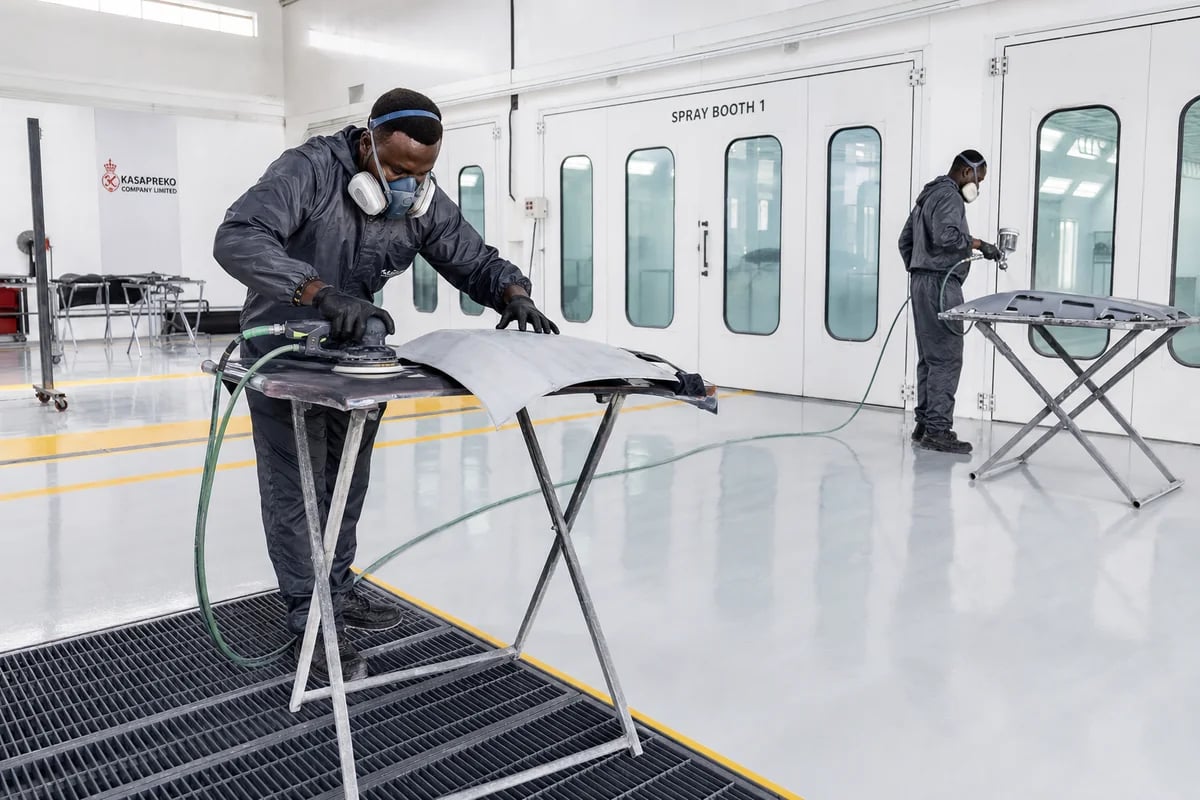
Automotive paint shops face aggressive solvent exposure, sustained heat-cycling, and explosive-environment classification — flooring must satisfy aggressive-chemical-resistance plus ATEX-compliant specification.
Notre approche
Industrial Floors Ghana delivers automotive paint shop flooring with solvent-resistant chemistry, ATEX-classified system specification, and full QC documentation against automotive-industry quality regimes.
Industrial Floors Ghana delivers automotive paint shop flooring with solvent-resistant chemistry, ATEX-classified system specification, and full QC documentation against automotive-industry quality regimes.
The Challenge
Automotive paint shop environments impose flooring demands that eliminate most standard industrial floor systems from consideration. Solvent-laden atmospheres, electrostatic dissipation requirements, chemical immersion from booth overspray, and the perpetual mechanical stress of trolley and conveyor traffic combine to create a specification environment where substandard flooring fails — not gradually, but categorically. A delaminated floor in an active paint booth contaminates the entire process, halts production, and triggers costly remediation against tight automotive assembly schedules.
In Ghana’s expanding automotive assembly and coachwork sector — concentrated largely across the Tema industrial corridor — this challenge is compounded by climate variables that accelerate substrate moisture migration and thermal cycling. Concrete slabs installed without rigorous ASTM F1869 moisture testing prior to coating application will fail regardless of the quality of the system applied above them. The substrate condition is non-negotiable, and the specification must begin there.
ATEX classification requirements add a further dimension. Where flammable solvent concentrations are present, the floor system must not introduce ignition risk through electrostatic discharge accumulation. This demands conductivity values verified against defined thresholds — not estimated, not approximated, but measured and documented for each installed zone.
The Industrial Floors Ghana Solution
Industrial Floors Ghana has delivered automotive paint shop flooring solutions since 1975 — 51 years of continuous industrial track record in one of West Africa’s most demanding specification environments. Our methodology begins with substrate assessment: laser-measured flatness mapping to DIN 18202 tolerances, ASTM F1869 calcium chloride moisture testing at defined intervals across the slab, and compressive strength verification before any system is specified. The floor is the foundation of the solution; we verify it before we build upon it.
The system specification for automotive paint shop environments draws on solvent-resistant epoxy and polyurethane chemistry selected for the specific chemicals present in the client’s process — not generic flooring-grade material, but system-matched formulations. Where ATEX classification requires electrostatic dissipation, we specify conductive or static-dissipative underlayers with grounding grid integration, delivering resistivity values within the 10⁴–10⁶ ohm range specified for ESD-sensitive environments. Full QC documentation — flatness reports, moisture readings, conductivity test certificates, cure verification records — is issued at practical completion.
Our site teams work within the operational constraints of automotive facilities: sequenced bay-by-bay installation where phased handover is required, overnight cure scheduling to minimise production interruption, and strict site protocols aligned to automotive-industry quality regimes.
Material + System Specification
- Substrate preparation: Mechanical grinding and shot-blasting to Sa 2.5 profile, followed by ASTM F1869 moisture testing — minimum 72-hour test cycle per zone
- Primer system: Moisture-tolerant epoxy primer formulated for high-humidity tropical substrates, applied at specification coverage rates
- Conductive/static-dissipative layer: ESD-classified epoxy undercoat with embedded copper grounding grid — resistivity verified to 10⁴–10⁶ ohm range, ATEX zone-compliant
- Topcoat system: Solvent-resistant polyurethane or epoxy topcoat, chemical-resistance rated against the client’s specific solvent and cleaning agent schedule
- Flatness compliance: DIN 18202 Table 3 tolerance mapping, laser-measured and reported at handover
- QC documentation package: Moisture test records, conductivity certificates, flatness reports, material batch traceability, and cure verification — full documentation issued at practical completion
Typical Project Profile
A typical automotive paint shop flooring commission engages 800 to 3,500 square metres across booth, preparation bay, and circulation zones. Installation is sequenced to accommodate active adjacent operations, with each zone handed over following QC sign-off before the next phase commences. Project timelines range from three to eight weeks depending on scope and phased-access constraints. Sectors served include automotive assembly plants, commercial vehicle coachwork facilities, fleet maintenance paint centres, and heavy equipment refurbishment operations — predominantly across the Tema industrial and Free Zones corridors.
Outcomes
- Paint shop floor system compliant with ATEX classification requirements — conductivity verified and documented, eliminating electrostatic discharge ignition risk
- Full solvent and chemical resistance matched to the client’s specific process chemistry — delamination and blister failure prevented at the specification stage
- DIN 18202 flatness certification issued at handover — trolley, conveyor, and jig movement on a confirmed-flat surface
- ASTM F1869 moisture compliance prior to system application — substrate-related adhesion failure removed from the risk register
- Complete QC documentation package — audit-ready records aligned to automotive-industry quality management requirements